

‘These little incremental increases really add up,’ resident says at First Ward budget meeting
By Bob Seidenberg
With the proposed 2027 city budget circling back to the City Council for a public hearing Monday, officials are receiving their strongest feedback on the tax and fee hikes they have proposed to close a $6 million deficit.
A small group of residents — some seasoned budget watchers, though — who turned out at a virtual First Ward budget presentation last week pressed officials on their rationale for increases to the solid waste and water rates.
City Manager Luke Stowe’s proposed $349 million budget also calls for a $5.5 million property tax increase, which would add approximately $180 annually to a median-value home’s bill.
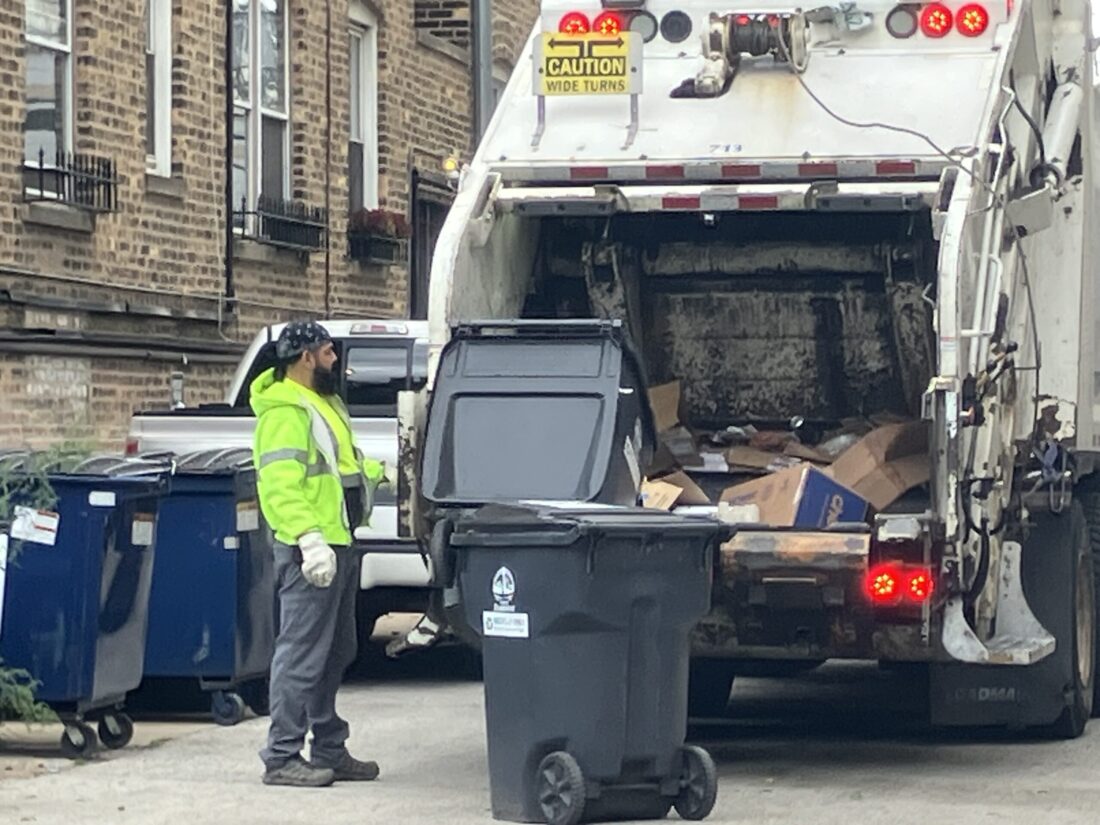
But residents and service users would see additional increases in a number of other areas, including a 9% rate hike for trash collection fees (depending on the size of the cart) and a 25% rate increase for water.
Solid Waste Fund: A long history in the red
In their presentation on the state of the city’s Solid Waste Fund at the Thursday ward meeting, Noel Rodriguez, public services bureau chief, and Brian Zimmerman, solid waste coordinator, spoke of a need to reverse a structural deficit.
The fund’s net operating income has been negative in every year since it was created in 2011, they said.
“Property tax support and General Fund contributions have helped make up a lot of the difference in this fund, but an ongoing fund gap remains, which the city is attempting to address with the increase,” Rodriguez said at the meeting.
There are also other considerations, such as the climate action goals the city is working toward — 75% waste diversion by 2035 and zero waste by 2050.
Officials are attempting to soften the fund gap to some degree using reserves. The city’s 35-gallon and 65-gallon trash bins are also viewed as “undervalued” in what they cost compared to the 95-gallon cart when taking into account having a truck and workers stop at a house to pick up refuse.
Officials are projecting monthly fee changes from $11.93 to $13.28 for 35-gallon carts, an 11.3% increase; from $14 to $15.60 for 65-gallon, an 11.4% increase; and from $26.95 to $28.20 for 95-gallon, a 3% increase.
Along with the cart increases, officials are proposing increasing the grocery bag fee from 10 cents to 15 cents. That would only apply to point-of-sale stores over 10,000 square feet, staff said in their presentation.
A side benefit of the bag increase is that, with roughly 350,000 bags currently distributed per month, higher fees can spur a decrease in usage, they noted.
Not moving the ball much, resident says
Robert Muno, a longtime Evanston resident and frequent commenter at budget presentations in the past, noted that increases last year generated roughly $1.25 million for the city as officials looked to right the Solid Waste Fund.
This year, the total looks close to $1 million, Muno estimated.
“We haven’t moved the ball forward all that much,” he said. “I mean, you’re not addressing the gap.”
Rodriguez didn’t disagree. “But the goal is really to address the funding gap, move away from property tax support and keep increases manageable while trying to maintain the service,” he said.
“We still have a long way to go to close the deficit,” he added.
As for water, a number of factors are placing financial burden on the Water Fund, Darrell King, the city’s water bureau chief, said in a presentation.
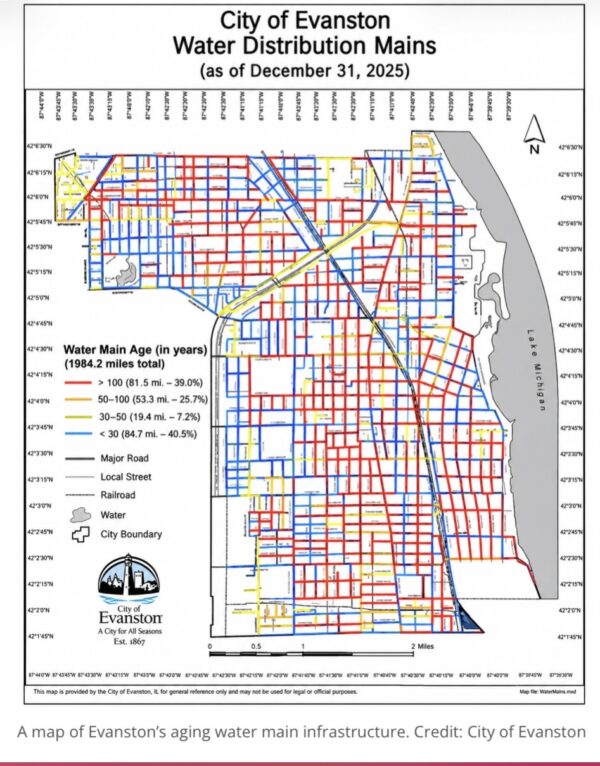
One big element is the need to replace the city’s aging water mains.
Another is that the city must replace approximately 9,240 lead service lines between 2027 and 2047, King said.
The replacement schedule could potentially be shortened by about a decade as a result of new U.S. Environmental Protection Agency regulations.
King is definitely not wishing that the case.
“By 2042, we would have over 30 miles of water mains 120 years or older, and we definitely don’t want that,” he said. “About 156 miles of water mains run through the the city; approximately 99% of those mains are used by the Evanston community.”
The city has expedited its construction schedule to replace or rehab approximately 3.2 miles of the water distribution system annually, up from one and a half miles.
Under the 25% increase scenario, the water rate would rise from $6.44 per 1,000 gallons in 2026 to $9.67 per 1,000 gallons in 2027, King estimated in a memo to the city’s Finance and Budget Committee. He projected annual combined water and sewer utility costs would increase by $193.30 to $1.393.22 in 2027 for the average household.
Muno said he hopes the city spending more money on water main work will help Evanston reach its goal of 500 lead service line replacements, “because from my point of view, from what I’m seeing, that has not happened since we started the program.”
As a distribution hub selling water to other communities, Evanston should have a lower rate, he argued. “I like to use this joke — if oil was water, we would be Kuwait,” he said.
“To say that we are in the middle of the pack to me just speaks to some sort of disconnect … in terms of what our bills look like,” he added, referring to a chart comparing water and sewer costs in Evanston to other suburbs.
In reality, King said the city accrues many benefits from its distribution role, including large improvements at the water plant being covered by wholesale customers.
“The intake project, that’s a $54 million project that doesn’t impact the retail rate,” he noted. “We’re currently doing a $21 million electrical upgrade. That project won’t impact the Evanston retail rate.”
Mary Rosinski, another longtime budget watcher, asked whether the city could tap into tax increment finance funds to relieve some of the burden. Evanston has unused money in a number of TIF districts.
“I think this [the water rate hike] is excessive, and I really wish that the city manager and the finance people would find ways to economize in the budget,” Rosinski said. “I just have not seen a lot of that. … These little incremental increases really add up for residents, and salaries don’t necessarily go up.”
Also, she noted, “I believe $4 million a year from the Water Fund [goes] into the General Fund. Is that something we should be doing?”
Julia Forgash, a newer resident who lives downtown, said residents would be able to swallow the pill more “if we understood what cost saving programs you all are implementing on the inside to address this deficit. Because right now, it feels like to the public that the burden is on us, and maybe it’s because we just aren’t aware.”
Residents will have another opportunity to comment on the budget at a public hearing scheduled for Monday’s council meeting at 6 p.m. in the Council Chambers at Morton City Hall, 909 Davis St.
Additional ward meetings on the budget are scheduled for November, and a Truth in Taxation hearing, another opportunity for residents to express their views, will be held at the Nov. 2 City Council meeting.
Typically, the final budget is adopted at the council meeting before Thanksgiving, which takes place Monday, Nov. 23 this year.