
By Bob Seidenberg
Evanston Public Library trustees have an intergovernmental agreement with the city at the top of their wish list as they enter a new year.
“What I would hope is that we’re not sitting here 12 months from now, and we are not in the same position,” said trustee Samia Amamoo, speaking during discussion of the issue at the Board’s last regular board meeting of the year on Wednesday, Dec. 17.
“It’s Christmas and we’ve got a long wish list,” she continued. “But we need to understand that negotiation isn’t that you get everything in your stocking,” she said, not specifying the city by name.
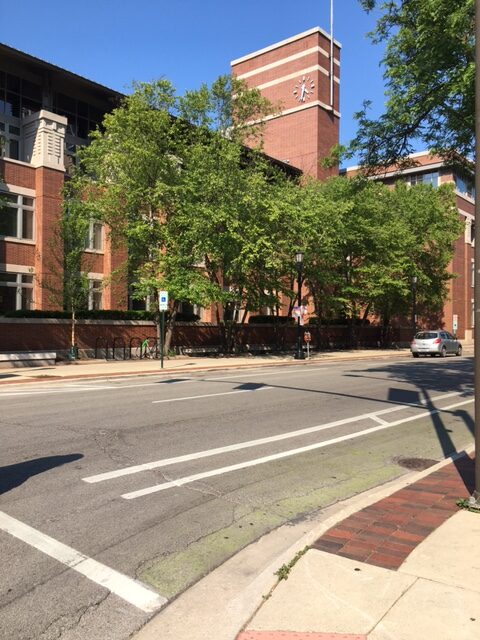
For several years now, the Library, with a much smaller budget than the city ($10 million versus $400 million) has been pursuing an agreement with the city that would clarify roles and cost responsibilities for services the Library receives, as well as maintenance on the city-owned main branch building at 1703 Orrington Av., where the Library has been footing most of the costs.
Breaking city silence on the issue, City Manager Luke Stowe reported at the Nov. 24 City Council meeting that there has been some progress made in recent discussions between the two bodies, on a new lease and agreement. Meanwhile, the Library agreed to place on hold a separate Human Resources manager, devoted to library matters, he said.
AFSCME, the union representing Library employees, had made that point a condition of the city approving the Library’s budget, maintaining that establishing a separate department would would split Library workers from fellow city workers, whose work issues and grievances go through the city’s HR department.
Library’s model of operation up for discussion?
At the Nov. 24, meeting, council member Clare Kelly, whose First Ward includes the main library, suggested that a “robust discussion” is also needed “about the form of library relationships in a city whether they’re component, departmental or district.”
“I think we’ve run into a few glitches here with this particular structure,” Kelly said.
The Library previously moved from municipal to component or the Library model in place now in 2012 after years of being lumped with other city departments and subject to across the board cuts during the city’s perennial budget woes.
The issue came after the South Branch Library was forced to close. Under pressure from community members, former City Manager Wally Bobkiewicz proposed in February 2012 that the City Council agree to an ordinance “to transfer authority for the appointment of the Library director from the City Manager to the Library Board of Trustees and recognize the ability of that Board to set the Library’s annual budget and assess a levy for its operations beginning in FY (Fiscal Year) 2013,” reported Mary Gavin, writing for the RoundTable at that time.
Library’s governmental structure ‘not a simple administrative decision’: Fulce
Reflecting on the question at the Dec. 17 meeting, Board President Tracy Fulce noted that when people ask, “‘Why isn’t the library just another city department?’, or there’s confusion around the nature of how the library operates, one important piece of context around that is that the changing of the library’s governance structure is not a simple administrative decision.”
Under Illinois law, she said, with the Library’s legal counsel sitting nearby, “moving a public library into a city department would require a public referendum, and that requirement exists for a reason: Libraries are meant to be protected public institutions, and any fundamental change on how they’re governed is something that the community itself must decide.
“And that safeguard is not accidental,” she said. “It reflects a long-standing understanding that libraries serve a distinct role in civic life — protecting access to information, intellectual freedom, literacy and access for everyone.”
Fulce said it’s also important to remember “why these conversations kind of began. Libraries have grown in size and scope and community impact,” she said.
The larger role they play was underscored earlier in the meeting, she noted, when trustees had discussed the library’s steps in regards to the state’s new Narcan legislation, requiring Illinois libraries to have the life-saving medication on hand for people experiencing opioid overdoses.
“Libraries no longer fit in that traditional departmental model,” she said. “Long-term planning, facility stewardship, staffing model and service delivery all require a level of stability and clarity that library governance is designed to provide, and that’s not unique to Evanston. Most of our peer libraries operate as district or independent libraries for the same reasons, and the structure allows them to plan beyond annual cycles, remain responsive to our community needs and ensure that decision-making stays focused on the mission of the library.”
At the meeting, the trustees also talked about the direction they would like to see the talks go with the city after Executive Director Yolande Wilburn returns from a medical leave, scheduled for January 13.
‘A strong middle path exists’: Library’s Financial chair
When talks start up then, Michelle Mills, the chair of the Library’s Finance Committee, said an agreement should be made a priority “so that we can reduce operational ambiguity,” Mills said.
She said one of the points trustees are striving to resolve concerns services the Library currently purchases from the city — largely administrative, such as Human Resources, but also include others such as grounds keeping. The Library’s current Memorandum of Understanding with the city calls for the Library to pay $350,000 annually.
“But the point that we need to resolve with them (city officials), Mills said during discussion, is “what are we purchasing when we purchase these services?”
A long-standing issue concerns “how fast does the city process, for example, recruiting positions (by the Library), and closing those positions out so that we don’t lose people,” said Mills, Wwhich has happened a number of times and we’ve been unable to fill positions.”
“We understand there’s a lot of competing pressures. This isn’t about criticizing the city departments,” she stressed. “It’s more about what we’re paying for these services. We need to assure that we’re getting things filled in a certain period of time so that we can close the position to move on.”
During negotiations, the Board suggested that transferring ownership of the main building could be a logical option, given that the Library has historically funded major capital projects directly.
AFSCME officials have expressed concern about the city transferring the main building as well as leasing it to the Library, enabling library leadership to borrow funds and creating taxpayer debt without taxpayer input.
Such a move would split Library employees from city employees and could be a prelude to privatization, loss of jobs and benefits and diminished services, they have argued.
At the meeting, Mills suggested there might have been some public confusion about the issue, resulting from the Board’s contracting with a consultant earlier this year to figure out what the cost would be for the library to become a totally independent district.
The Board announced during the budget process that was not the step the Library was taking, taking into account some of the costs that would be necessary to make that jump.
The exercise was necessary — “a responsible move for us,” to do,” Mills said, “to understand the value of the services versus what the library would be getting in the private market.”
While the Board’s decision wasn’t to separate, that may have become muddled to a lot of people, she said.
Having the building transferred, though, would allow the Library to borrow against it to access the $20 plus million needed “to modernize this building for safety, deferred maintenance, etc., etc.,” Mills said.
“And I think that is a really strong middle path that gives the city the library they deserve — a safe space that starts to build in the technological advancements that we need to make into a modern library,” she said. “And if people disagree, we can talk about why, and if there’s other alternatives, we’re very interested in learning more about what the alternatives are…but we just don’t see the alternatives right now.”