


By Bob Seidenberg
Evanston City Council members appeared to agree Monday that a new intergovernmental agreement between the city and the Library would be better than the so-called “nuclear” option that would see the city taking control of the library.
“I think it’s important [to try an intergovernmental agreement] before we blow up the system that we have,” said Councilmember Shawn Iles, who was a former member of the Library Board.
Although councilmembers didn’t take a formal vote on the issue because it was set for discussion only, a consensus agreed on a 90-day period to allow city staff to negotiate a new intergovernmental agreement between the two entities.
Monday’s meeting marked the first discussion of a referral by Councilmember Matt Rodgers, 8th, concerning the status of the library and whether it should return to being a department of the City.
Leading off the discussion, Iles, who served 10 years on the Library Board, including two years as president, said he was in agreement of the need of an updated agreement with Library officials. He also reminded councilmembers of the library conditions when it was last under city control, prior to adopting a hybrid model of government which gave the city minimum control of its budgets.
“There’s a reason that Evanston Public Library is significantly underfunded per capita than most of its neighbors,” he pointed out.
“You know when times get hard and budgets are tough, historically the city looked to the library to cut staff for layoffs and to cut funding, and assets were neglected,” Iles said, adding that the Library foot the costs for its then North Branch Library and its main branch even though the assets were owned by the city.
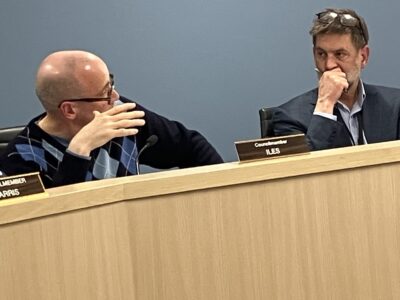
Councilmember Clare Kelly, 1st, argued hardest for bringing the library back under city control.
Other council members expressed concern about the cost of a hypothetical legal battle with the Library over whether the city has authority to return it to a city department.
Rodgers, who made the referral, argued for more discussion of the options.
“I am concerned about us being responsible for the actions of the library without any accountability from the Library back to the council,” said councilmember Rodgers. “I don’t know if that’s something that we can negotiate that in an IGA.”
Other council members pressed Alexandra Ruggie, the city’s Corporation Counsel, the city’s legal chances of winning a lawsuit changing the Library back to a city department.
Ruggie said a problem officials are running into on the question is that there is no legal precedent. The current Library model falls under the 1970 Library Act, which was instituted before the 1970 Illinois Constitution created Home Rule authority, such as the city has.
Councilmember Jonathan Nieuwsma, 4th, observed that “an argument can be made that we do have the authority to departmentalize the library, but there’s no precedent for that, and perhaps a valid or counter argument can be made that it’s not allowed.”
Councilmember Tom Suffredin, 6th, noted that council members have had “library issues come to us for paying that we have no role in…and I find that frustrating.”
He said that although he supported moving forward with the IGA, he didn’t think option 3 — the plan for returning the library to department status — should be off the table either.
To date, he noted that “a lot of our issues have been over clarity around roles and responsibilities.”
In the end, City officials listed three options council members might take, in response to the referral:
