



By Bob Seidenberg
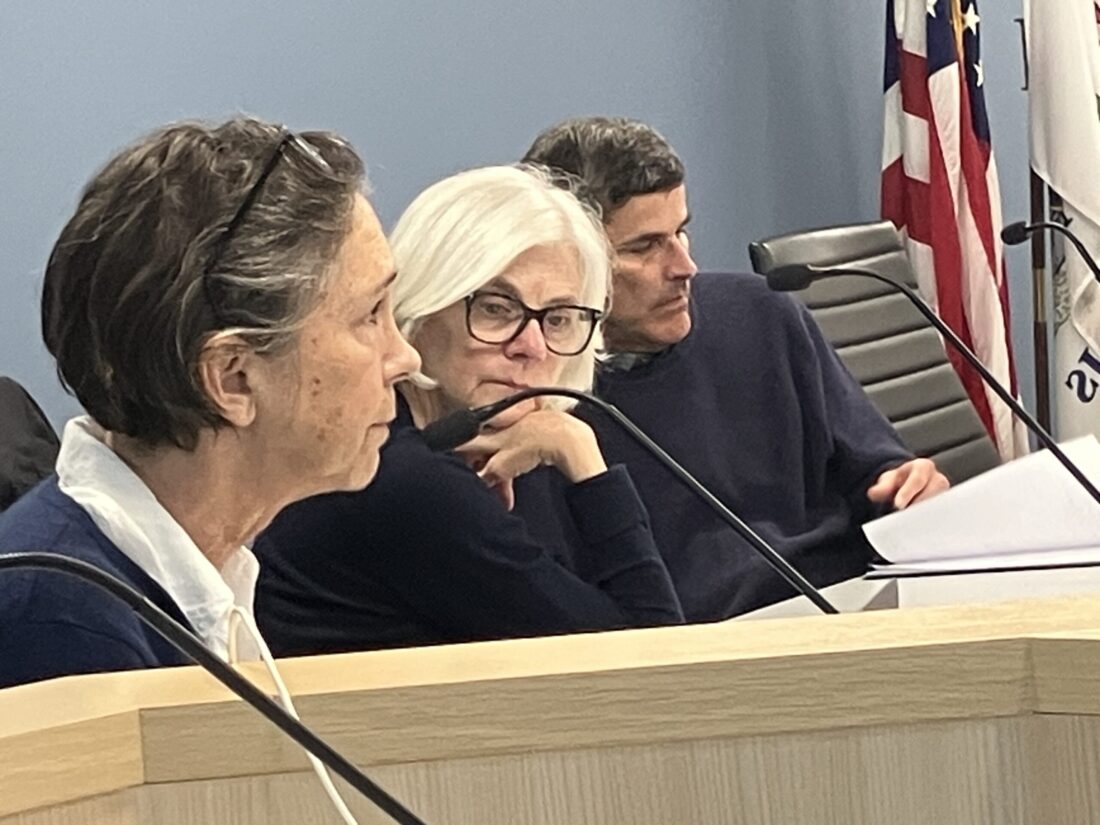
Some members of the city’s Finance and Budget Committee urged City Manager Luke Stowe to take another look at the staffing recommendation in his recently issued budget.
Stowe’s budget called for a reduction of six positions from the city’s full-time work force — around 700, according to the city’s website.
Another 1.15 positions would be reduced at Evanston Public Library, a separate taxing body from the city. The library has 100 employees, 58 full-time and 42 part-time, according to records online.
“That just seems like far too few,” committee member and First Ward Councilmember Clare Kelly said in discussion. “I would have expected far more,” she said, maintaining the city appeared “very heavy” in midmanagement and administrative positions, according to the budget proposal.
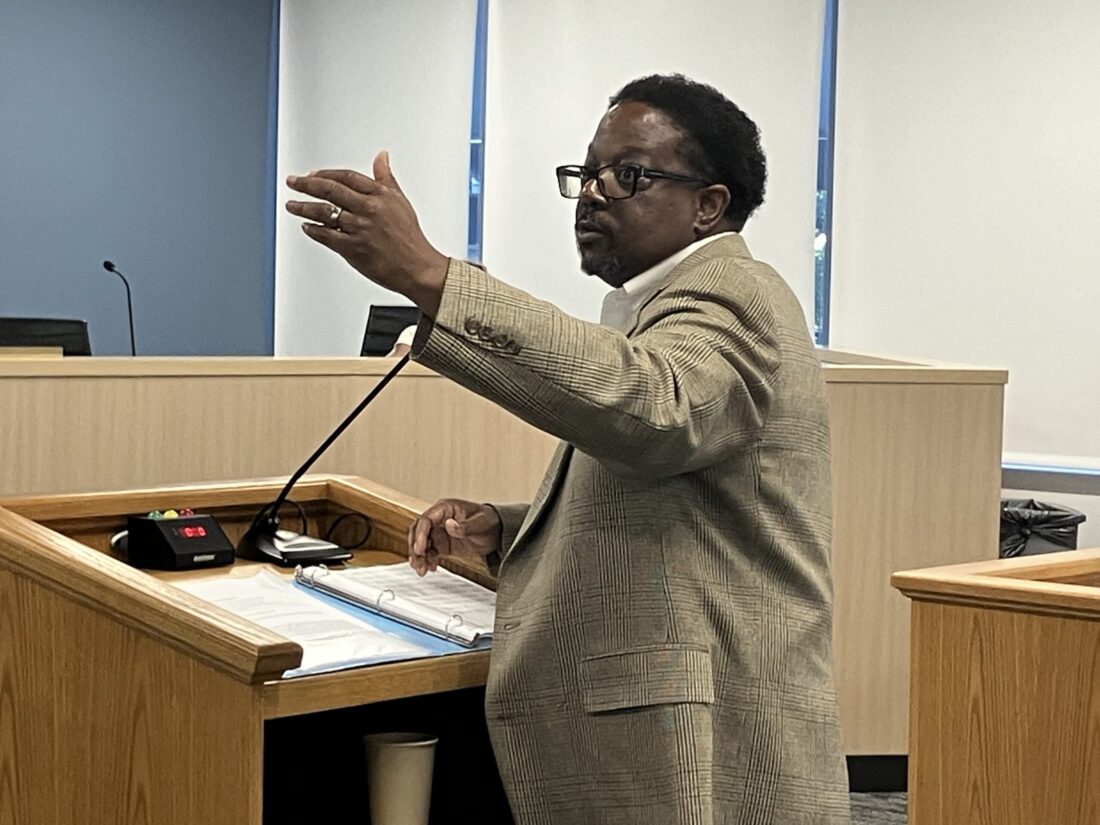
Committee and Sixth Ward Councilmember Tom Suffredin observed that in an email from Stowe a few days before the meeting, the city manager had said that he was continuing to review positions for opportunities for reductions. He asked Stowe, standing at the lectern, “How do you see that [the review of the issue] matching up with the budget calendar so that we can weave it in if there are opportunities identified for further reductions?”
The city manager responded: “Thank you for that question. I have had conversations with some council members about positions and reductions. Those conversations are ongoing, and obviously, if there’s a critical mass of support for something particularly, then we would bring that forward.”
Suffredin said that upon his first reading of the budget, “it seems like the personnel reductions are fewer than what will ultimately be necessary, and how we get to that [a decision] in a measured and reasonable way is something that, in the early parts of the budget, we should give some consideration to.”
The city manager responded that there are “different council members in different camps on this issue, and so we’re still kind of working with that consensus.”
The city manager’s budget makes use of higher than expected sales tax and other revenues fueled by inflation and once again taps the city’s excess reserve fund to cover a projected $6.1 million deficit between revenues and expenditures in the city’s General Fund.
It also calls for a $5.14 million increase to the city’s property tax levy and a 25% water rate hike officials say is needed to support infrastructure improvements, including replacement of the city’s aging water mains, an ongoing program.
The city is at the start of the budget process with hearings to be held in wards and at the council in coming weeks. Typically the council has approved a final budget, the city’s blueprint for spending in the coming year, at its meeting before Thanksgiving.
Committee members expect to hold a second meeting later this month to discuss staff response to their comments.
In his presentation to the committee at Morton City Hall, Clayton Black, the city’s deputy chief financial officer, noted that revenues were showing a roughly 5.5% increase this year. “We’re seeing a lot of economy-based revenues doing well,” he told committee members. “Part of that is the result of inflation.” Simply, “Things just cost more than they did a couple of years ago. So we know that’s contributing to it, but we’re also seeing month-over-month sales tax doing really, really well.”
Focusing on the 2027 budget, officials see revenues increase by 6%, he said. They see expenses increasing to pay wage hikes [negotiations are underway between the city and its three employee units] and to pay health insurance costs, he said.
“So that brings us to an operating deficit next year of $6.1 million, requiring the use of $6 million in fund balance [sometimes referred to as the city’s ‘rainy day’ fund to be used at critical times such as the pandemic] to balance the General Fund,” Black said.
As a service-based organization, the city’s largest expense “is for our people,” he said.
Approximately 59% of the city’s costs in its General Fund go for salary, 22% for health insurance, and “this is also where we capture the public safety pension contribution.”
Above the red line
The excess reserves, which stood at $57 million after COVID, are now at $37 million. Dipping into the fund to help balance this year’s budget, will dip it down to $31 million, he said.
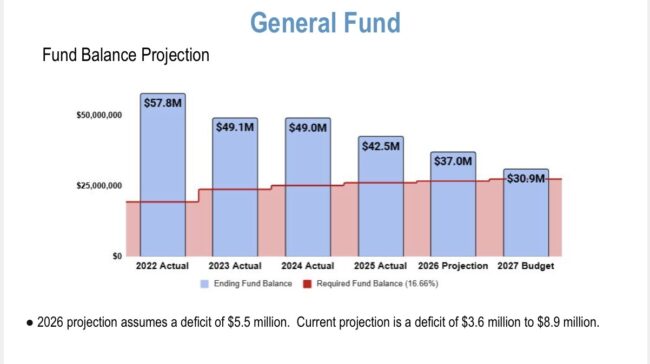
“I want to highlight here and remind the committee,” he said, “that over the last three years we have seen $20 million in permit revenue from the Northwestern stadium and educational building projects.”
If not for that, excess reserves would stand at $17 million this year, he said.
“This would be a different situation without those projects, and relying on those projects in order to keep above [this] red line is not a great formula for success,” Black maintained.
The city is still awaiting results of an actuarial study to determine its annual contribution to police and fire retiree pension funds for the 2027 budget, he noted.
Over a five-year period the city has contributed $37.7 million from its fund balance and excess reserves to that fund without raising the property tax.
“We’ve certainly made progress on funding our public safety pensions [once among the lowest-funded in the state, resulting in the city piling up millions of debt in interest] but we’ve seen a significant draw in our General Fund balance.”
In fact, Black said, when he and Hitesh Desai, the city’s chief financial officer, met with Moody’s, the credit rating agency whose decisions on a city’s credit status could affect hundreds of thousands in interest costs, “they did call some concern to our 16.6% reserve [policy]. They said it was one of the smallest reserves they’ve seen in the region, if not the smallest among many of our peers, especially communities our size.”
In committee discussion, David Livingston, the member most vocal about the need to find alternatives to the reserve, maintained that “while it’s really encouraging the city has gotten another year without having to make deeper changes, the sooner officials get to work on addressing the structural imbalance between revenues and expenditures, the better.”
“The city has been very fortunate with these excess reserves due to the savings we had in the pandemic,” he said “and also the incremental building fees [Northwestern’s stadium and other building projects] have generated.”
The funds have helped the move to put pensions on a 100% funding track, he said.
“But next year we have to come up with structural changes in a world where we don’t have excess reserves to bail us out,” he said.
Looking at the budget, he noted staff has highlighted a 2% increase for wage and salaries in negotiations with the city’s three employee groups, which are currently underway and where “it’s very difficult to say where we’re going to end up.”
Not into ‘Nice to have’: Livingston
A big increase in employee health insurance needs to be looked at, with workers currently footing between 13% to 15% of the costs under the current contract.
On capital needs, he said, “there are obviously things we have to do like the lead pipe replacement, like projects that are ongoing. But this would be the perfect time to take a hard look at the capital plan and say, ‘These are nice to have. This is a high interest rate environment. We’re not into nice to have right now.’”
Livingston said, “Let’s focus on completing what we have and strategically thinking about where we want to be. …What’s our car program [fleet services] look like?”
He asked: “What services could be outsourced to make money? Fees at the community centers, for instance. I think we talked about that last time.”
Keep park funds separate: Kelly
Besides the staffing issue in discussion, Kelly noted that the city keeps a lot of reserve funds besides the General Fund, more than most cities. Evanston should consider eliminating reserve funds policies in many cases, and then “you just budget responsibly,” she said. She also requested that the Parks & Recreation Fund be kept strictly separate from the General Fund, which supports basic city services, to ensure greater transparency.
Food & beverage tax an opportunity: Chow
Committee member Candance Chow said she was surprised the proposed budget didn’t include a change in the food and beverage tax, one of the alternative revenue ideas that staff had suggested at a previous meeting.
Implementing a 1% food and beverage tax would generate an estimated $1 million in revenue, staff estimated.
“I just feel like that is an opportunity for us,” Chow said, “economic-type driven elements of our budget are increasing, and we have increased economic activity that we can capitalize on that for programs of funding without hiking taxes.”
She said a game plan is also needed on the city’s capital needs, which include a new city hall, police headquarters, the Noyes Cultural Arts Center, as well as an extensive renovation to the city’s service center “because we’re not going to get ourselves out of this through bonding in terms of maintaining and supporting the footprint of assets that we have today.”
Councilmember Matt Rodgers (8th Ward), chairing the meeting, noted that the group is due to receive a report on the issue from the city’s Putting Assets to Work committee, which Finance and Budget is to look at in November.
In support of a deeper look at cuts, Rodgers said, “This is not something I think we have to raise taxes to get our way out of it. There have to be cuts.”
He stressed that “we have to make sure that we’re delivering services to people for the money that we’re asking them to pay, and that’s not happening right now in the city.”
He pointed to garbage pickups where the city made a change to a new carrier in recent years.
“I get 12 complaints in every 311 report, minimum, of people who say they didn’t pick up my trash again.
“So we’re asking people to pay more for an inferior service and I think that’s what we need to be looking at,” he said.
Editor’s note: This story has been changed to add quotes from Luke Stowe and Tom Suffredin.