


By Bob Seidenberg
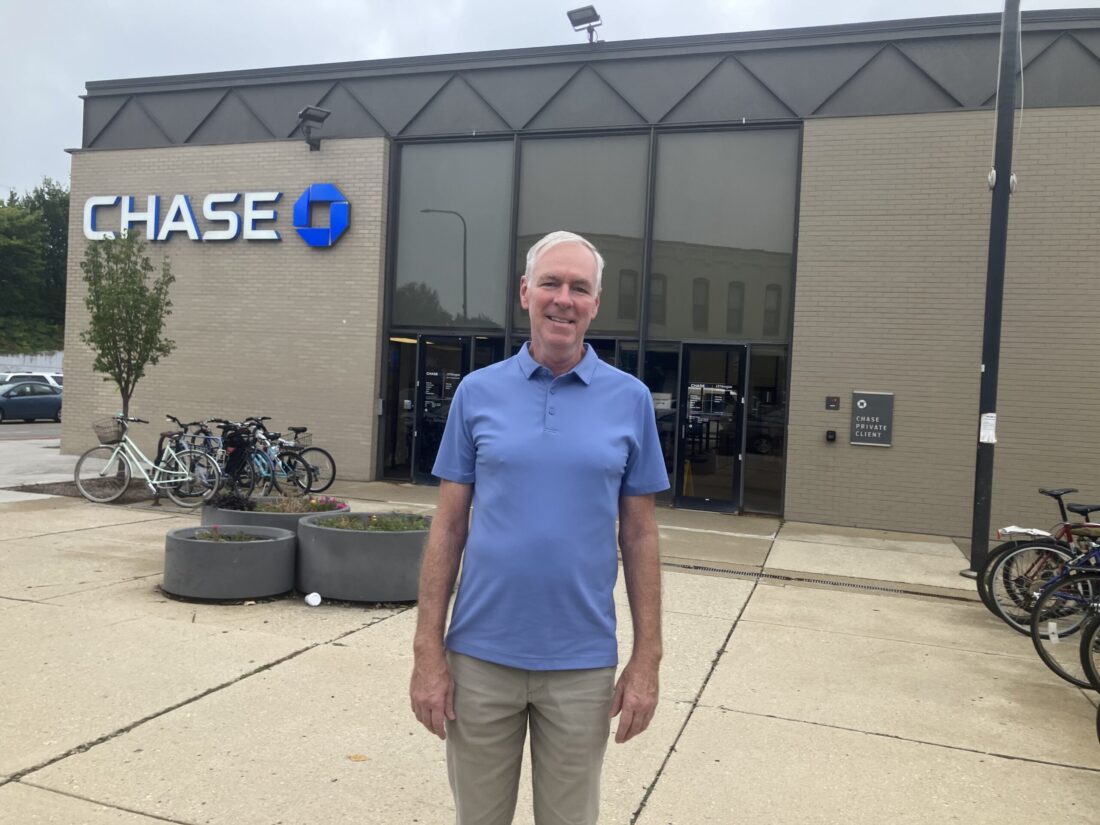
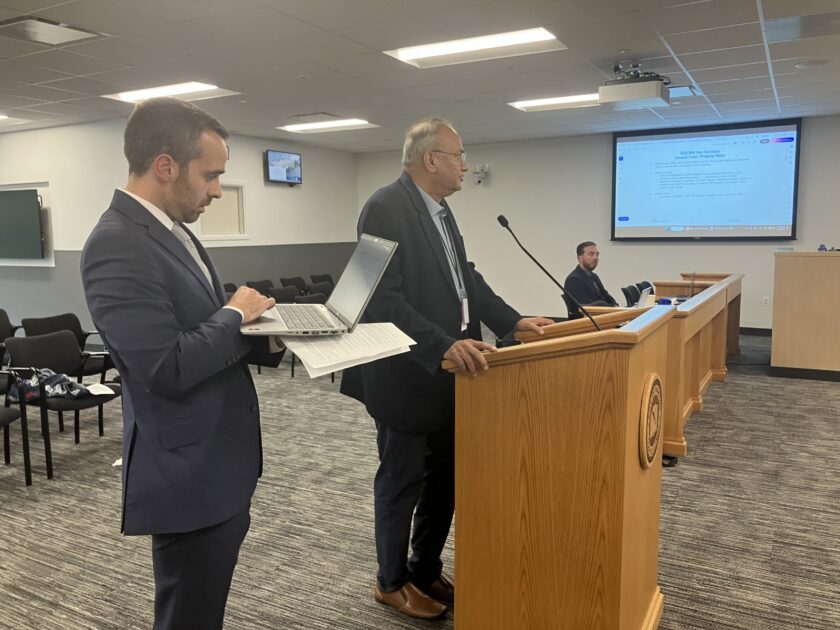
An Evanston resident made a passionate pitch Sept. 15 for the city’s Preservation Commission to designate a Chase Bank building on the southwest corner of Central Street and Green Bay Road as a historic landmark, a move that would prevent Chase from demolishing the building to put up a new bank.
James McKee, the south Evanston resident who filed the landmark nomination, presented for close to 40 minutes and highlighted the background of its late architect David Haid, an Evanstonian and associate of world-renowned architect Ludwig Mies van der Rohe.
He said the building “is a remarkable intact example of Miesan modernism — an important expression of the International Style that is increasingly threatened as buildings of this area are altered or demolished.”
Chase Bank has taken a counter view, maintaining in a Sept. 10 objection letter that while Haid’s body of work is consistent in its modernist International Style, none of the structures he designed is an extraordinary example of such “style.”
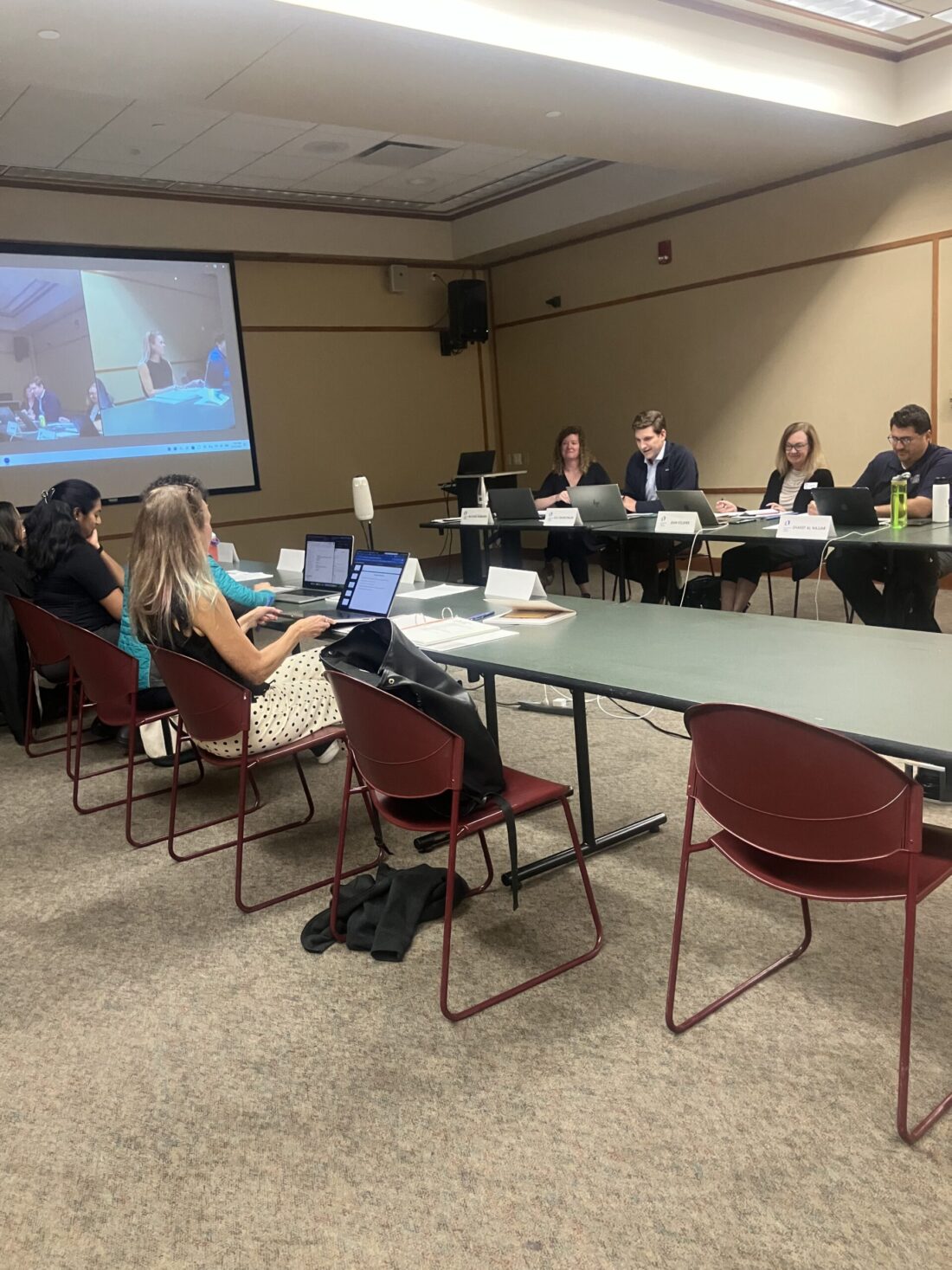
Chase is seeking to demolish the existing 1979 structure and replace it with a similarly-scaled, single-story prototypical branch bank building, and has requested 60 days to prepare a report challenging the nomination. Preservation Commission members voted unanimously Tuesday to forward discussion of the issue to their Nov. 18 meeting.
In his nomination form, McKee argued the building met several criteria in the city’s Preservation Ordinance to qualify as a landmark structure, namely being the “exemplification of an architectural type” and the work of “a significant local, regional or national architect.”
He stressed that he is advocating for landmark designation for the Haid-designed building and not for preservation of the large surface park lot which sits to the west.
“Some have suggested that this prominent location across from the train station may ultimately be better suited for a larger residential or mixed-use redevelopment, although such redevelopment is not currently under consideration by Chase,” he noted.
As designed by Haid, for eight years an associate of van der Rohe before establishing a successful practice of his own, “the building is a distinguished example of International Style (Miesian) architecture,” he said.
It “embodies the clean lines, disciplined proportions, high-quality materials and restrained elegance that characterize the Miesian tradition,” he said in his nomination form.
‘Boring’ vs. ‘a remarkable experience of modernist architecture’
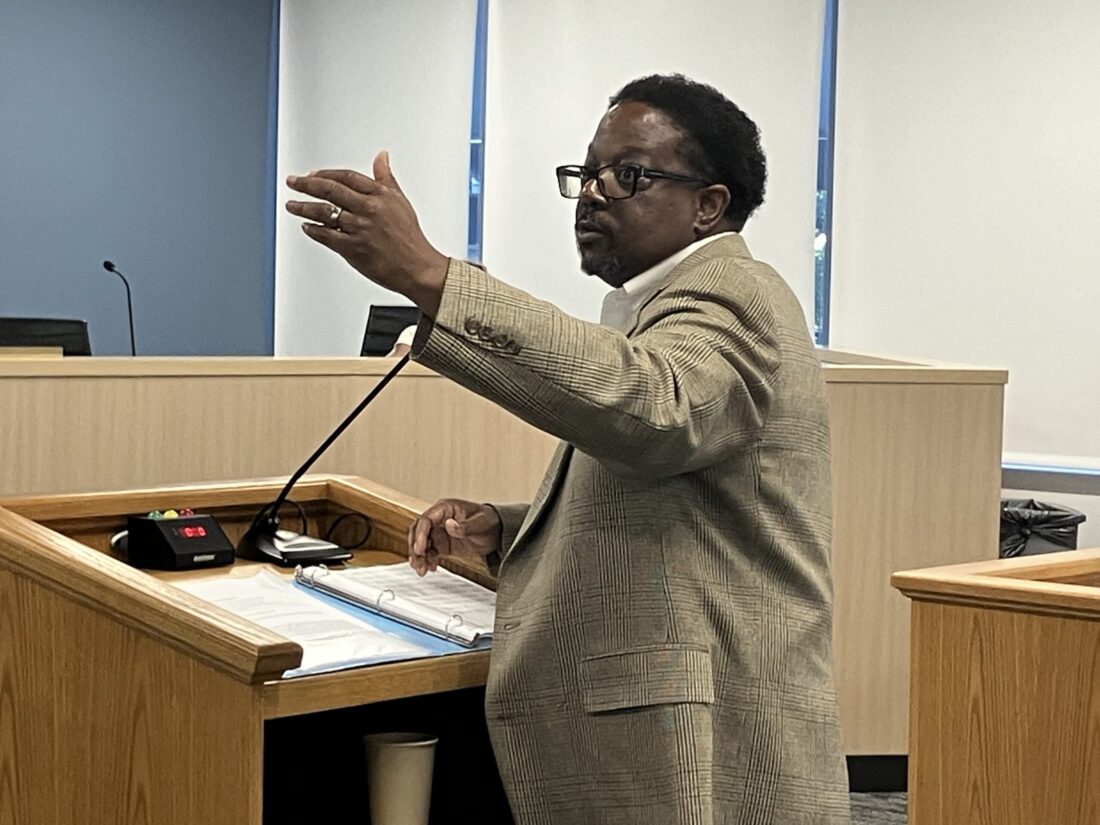
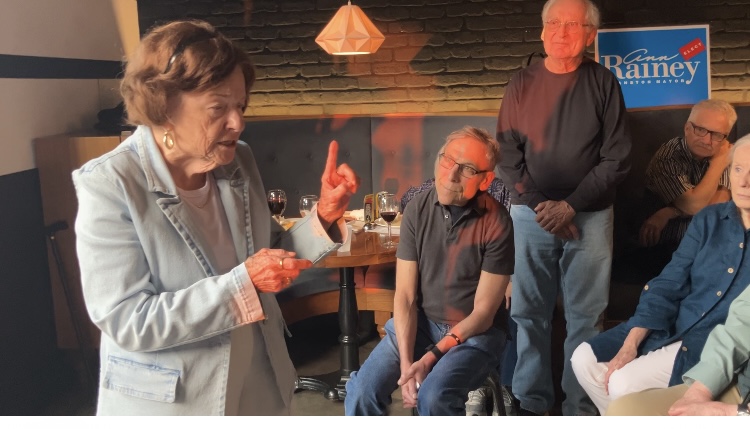
Several residents took both sides of the issue during the public comment portion of the session.
Spencer Stern, who identified himself as a Seventh Ward resident and Chase Bank customer, said he hopes the building is taken down.
“I find it nondescript, boring,” he said.
Erecting a new bank in its place would generate “more foot traffic on Central Street, which is what we need here,” he said. “We need more people going in person to the bank and after they go to the bank and [deposit their] money, whatever they do they go up and down Central Street. They frequent our shops, they frequent our restaurants.”
Jerry Goldman, another speaker, challenged that view. Foot traffic along Central Street is driven by the cultural activities, he said. “This building stands alone as a remarkable experience of modernist architecture,” he declared, “and that’s why it deserves to be preserved.”
“I would trust them to put a tasteful building up,” he said about Chase, “which I’m sure they would be willing to consult the commission about.”
Haid: ‘One of our own,’ says former owner of Lucky Platter
Eric Singer, the former owner of The Lucky Platter on Main Street, also addressed the commission, speaking in support of designating the structure as a landmark, recognizing architect David Haid’s work. His parents were friends with the Haids, he said.
David Haid “was one of our own, one of our architects,” he said. “This is our town. I’m not in love with that building on the outside, but on the inside it’s kind of special, and I do think we could do something with it. I think there’s other uses that could be done with that building, and I think we really need to protect the community.”
McKee amassed support from a number of experts active in preservation — including the Landmarks Illinois preservation group, which had previously put the site on its watch list.
Jonathan Solomon, who heads Preservation Future, noted that Evanston “protects a great deal of its nineteenth- and early twentieth-century architecture and comparatively little from the second half of the twentieth century.”
Conversation with teller led to preservation effort
Driving his effort, McKee said, “although I’m certainly not an architectural historian — just an architecture fan, as well as a homeowner and apartment building owner here in Evanston — I’ve long admired Miesian modernism and the International Style. My wife and I took a walking tour of the ITT campus some years back and especially marveled at the cohesiveness of the campus and the careful details of many of the Mies-designed building.”
A bank customer, he said he first learned of Chase’s planned demolition of the building from a bank teller. “I’m always admiring the spaciousness of it, and I asked or said to one of the tellers, ‘Boy it’s a wonderful place.”
“Oh, it’s being a torn down,” the teller replied.
He said the Chase building fits within Haid’s broader body of independent work, including his own residence in Evanston, the Hickman House in Lakeside, Michigan; “the Rose Auto Pavilion in Highland Park — “the glass-walled garage famously featured in Ferris Bueller’s Off,” he said in his nomination.
The Robie House lesson
He pointed to a famous preservation story that took place in Chicago, in support of his effort.
“Frank Lloyd Wright’s Robie House, also 47 years old at the time, was so under-appreciated that it was proposed for demolition.”
“This seems almost unthinkable today: In a 1991 national survey of 829 architects, the American Institute of Architects ranked the Robie House among the greatest all-time works of American architecture. None other than the nearly 90-year-old Frank Lloyd Wright personally campaigned on site to save the structure.”
“Important modern buildings are often most vulnerable before the public fully recognizes their significance,” he said in his nomination and as well in remarks after his presentation.