A move to create parking free zones would result in important revenue loss, putting pressure on officials to consider a property tax hike in their upcoming budget, officials warned.
By Bob Seidenberg
Establishing free parking in some business districts would have a strong fiscal impact and place pressure on the city to make up the lost revenues elsewhere, a city staff member told members of the Economic Development Committee on Wednesday.
Deputy City Manager Carina Sánchez and Michael Rivera, the city’s interim administrative services director, shared figures with the committee, which has shown interest in creating free parking in some places as a stimulus for business districts recovering slowly after COVID.
The city’s parking fund currently contributes more than $5.1 million annually to support broader city operations, officials said in their report. Nearly $3 million of this is transferred to the General Fund, $1.76 million pays for parking taxes and about $369,000 pays for insurance.
“In downtown Evanston, if you want to have one parking spot to be completely free,” it would cost the city just under $2,700 a month in revenue, Sánchez said during her presentation.
“For every $100,000 in parking revenue lost, Evanston businesses must generate $4.4 million in additional general merchandise sales to fully replace the lost municipal revenue via local sales tax revenue,” the staff report states.
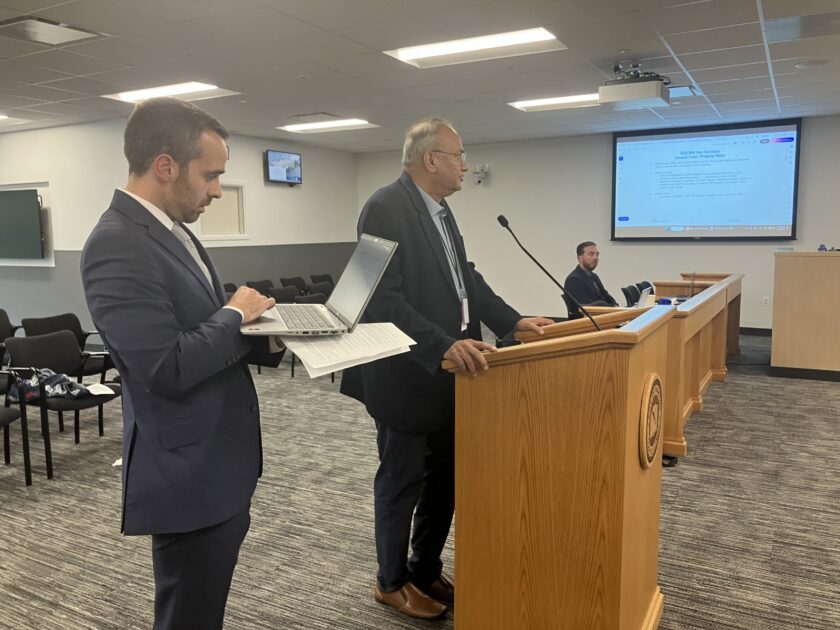
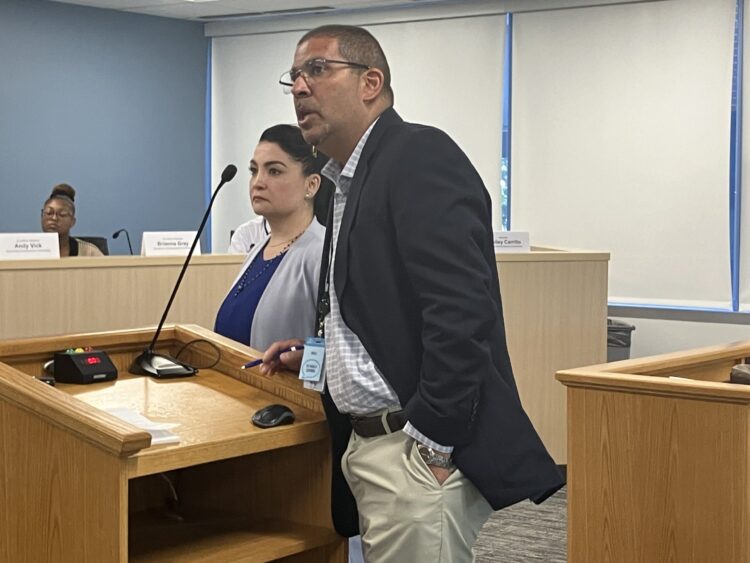
Left) Deputy City Manager Carina Sanchez and Michael Rivera, the city’s interim administrative services director, present some facts about the city’s parking system in a report to the city’s Economic Development Committee at their July 22 meeting.
“Free parking risks pushing the parking fund into deficit and shifting the burden to residents via property taxes or other fees and/or municipal service cuts to maintain services,” the report continues.
Committee officials referenced back to findings from a spot survey of 155 business owners across the city’s business districts, conducted at their June meeting. The survey found that “customers are choosing to shop and dine in neighboring communities — specifically Wilmette, Skokie and Old Orchard — due to the availability of free, hassle-free parking,” said Paul Zalmezak, Evanston’s Economic Development Manager.
Officials touched on other areas in their detailed report. Business district metered zones see plenty of activity, Sánchez and Rivera said in their presentation.
Downtown Evanston’s 1,495 meters exhibit the highest “turnover” velocity — each metered spot in that district receives an average of 95.5 transactions and $2,661.96 in revenue per month.
“One of the things that we noticed is that more and more people are navigating toward using the online app [Park Evanston] rather than the actual kiosks,” Sánchez said.
Since 2024, she said, app usage has gone up from 76% to almost 82%, generating more than $10 million in revenue during that time.
Holiday validation program popular, but expensive
The two hours of free parking the city offers during the holiday season amounts to a $4.35 value that the city absorbs per transaction. Over three holiday seasons with 120 total active days, the universal app code for the service was redeemed nearly 100,000 times, providing $286,722 in direct parking revenue to visitors but adding to a total loss of $308,000 to the city.
(Left) Deputy Chief Financial Officer Clayton Black and Hitesh Desai, the city’s Chief Financial Officer and Treasurer, brief the members of the city’s Finance and Budget Committee at their Wednesday, August 5 meeting.