
By Bob Seidenberg
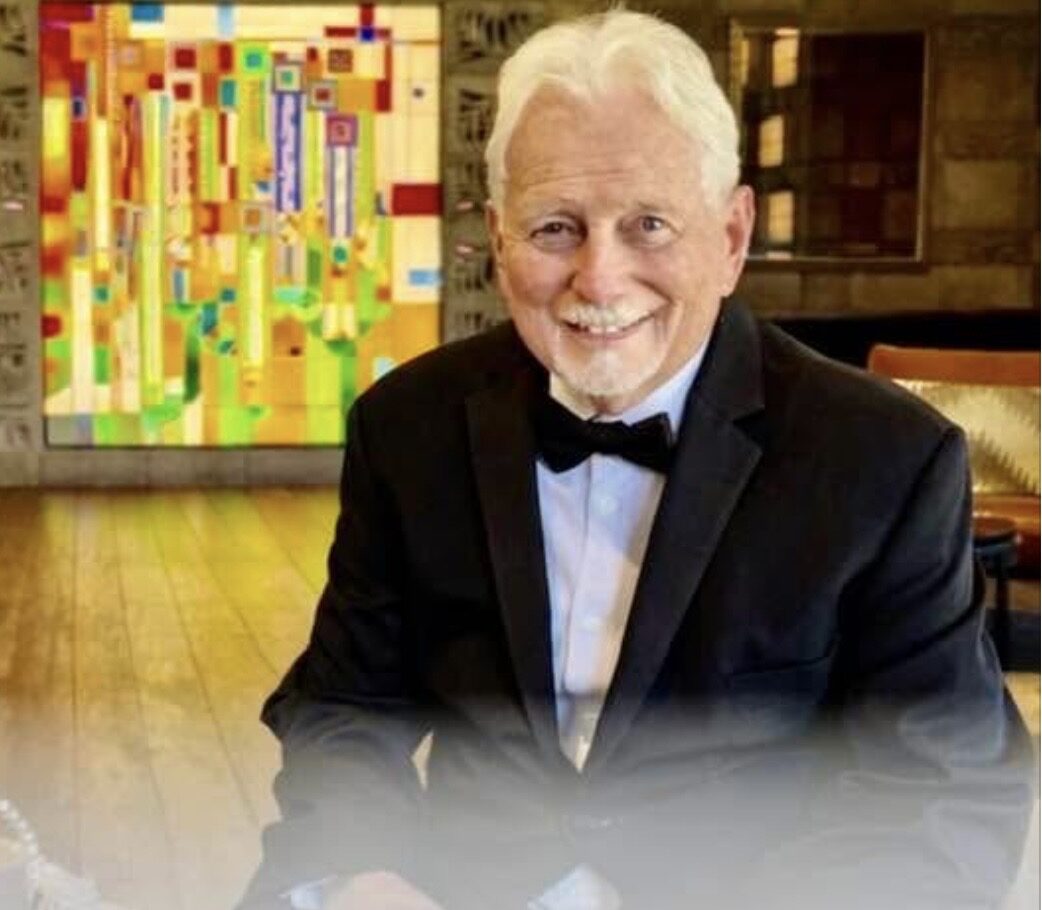
Several hundred people filled a Niles banquet hall on Friday, June 26 to celebrate the life of retired Evanston Police Department investigator Carlos L. Mitchem Sr., who with his partner Michael Gresham played a key role stemming the spread of street gangs in the city during the early 1980s.
Mitchem died on Jan. 28. He was 83.
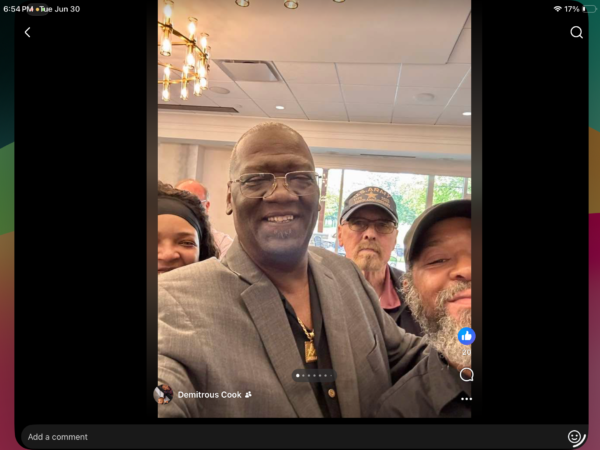
The two plainclothes officers riding in a blue 1977 Plymouth were a familiar sight on the streets as the city grappled with an emerging gang problem. Teaming with Gresham, Mitchem “was doing community policing even when it wasn’t called community policing,” said former EPD Chief Demitrous Cook, presiding over Friday’s event.
“We weren’t doing what the felons were doing,” added Cook, who would go on to succeed Gresham as Mitchem’s partner after Gresham was promoted. “We were getting to know them, building relationships so when [situations] went down, we were in position to have that information.”
Loyalty and a prodigious memory
Born and raised in West Virginia, Mitchem grew up in the town of Beckley, the son of a coal miner. He was a veteran of the U.S. Marines Corps, serving during the Vietnam War.
Altogether, he spent 37 years with the Evanston Police Department, retiring from its detective bureau. He spent another 10 years after that working as an investigator with the Cook County State’s Attorney’s Office.
Retired police lieutenant Daniel Mangas, like Mitchem a Vietnam War veteran who joined the department around the same time, noted that if “he was your friend, he was loyal and he was going to be your friend for life.” He also marveled at how Mitchem could retain information: “You’d talk to him, and he’d say, ‘What was that guy’s license plate?’ He’d come up with it right away, just from memory.”
“He had a way with people. He treated them with respect. Even bad guys, you know, they’re human beings, and he always said everybody should have respect. And he was honest with them: He didn’t tell them he’d do something that he couldn’t do, and they liked that,” Mangas said at Friday’s ceremony. “He didn’t belong in patrol. … He was good, but he belonged in investigation because he could talk to people, and they would just talk to him.”
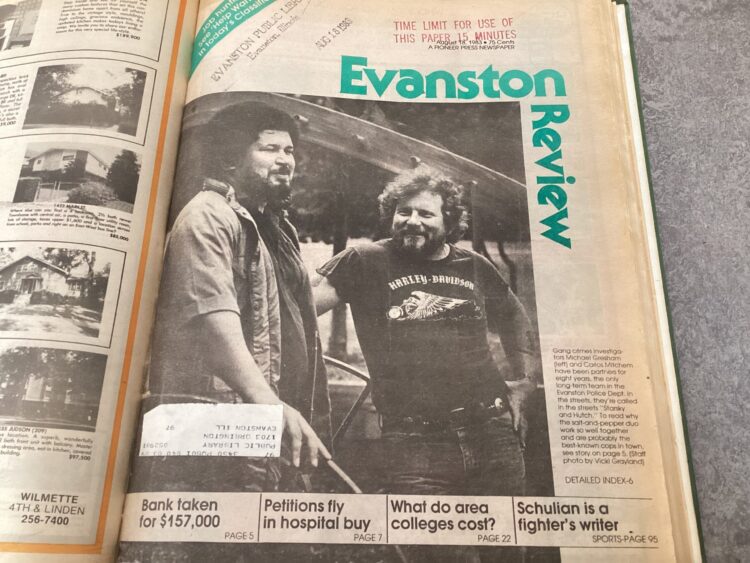
Yet Gresham admitted in a 1983 interview with Evanston Review reporter Marcia Nickow that he initially didn’t think the pairing would even last days, let alone years. Gresham described himself as a “militant cop,” maintaining that few white officers had been sympathetic to his push for the just treatment of Black victims, suspects and community members.
He said he rode in Black neighborhoods, and that if Mitchem didn’t like that, he should look for another partner. But Gresham recalled to Nickow that Mitchem replied, “That’s where I ride too, so you ain’t telling me to do nothing I don’t already do.”
Gresham, who wasn’t able to attend Friday’s gathering because of health problems, said in a phone interview that any concerns he had dissolved almost right away.
Mitchem would help out community members with food and other resources whenever they needed help, “and it wasn’t something that was premeditated — it was just natural for him. He was just such a kind-hearted person,” Gresham recalled.
“I didn’t have to worry about him mistreating anybody or abusing his power, and we just got along, we just hit it off. He told me about living in West Virginia, and how there were times when they didn’t have food, and that they got saved by Black families that were in the neighborhood where they lived. And he said, ‘Hey man, if it wasn’t for them, we probably would have starved to
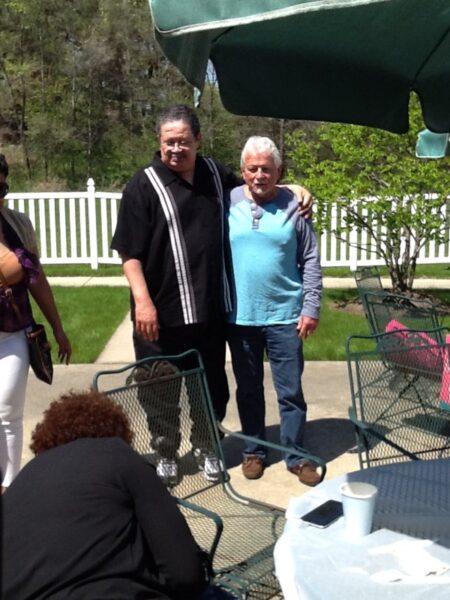
Gresham acknowledged the two challenged conventional wisdom at the time, facing suspicions from within the department.
“Carlos and I just had this thing, you know. Even if a person committed a crime, he was still a human being, and we tried to accord them all the dignity and privileges of anybody,” he said.
“We arrested somebody, we brought them to the station. We didn’t care if he made one phone call or 20 trying to get his bond together or let people know [of their status]. We didn’t see [anything] wrong with that, but other guys did. They only allowed one phone call.
“If we made a promise or told somebody we’re going to look for them in court, stuff like that, that’s what we did. We didn’t care if the prosecutor and other police officers didn’t understand that or didn’t like it. We had a prosecutor tell us one time, ‘Why do you care what happened to him?’ And I said, ‘Look, we promised that we were going to stick up for him, and that’s what we’re going to do.’”
The ability of the two “to develop cases even in the absence of helpful victims and witnesses makes some gang leaders and members fear them,” Nickow wrote in her 1983 article. They were able to make a case after a shootout between rival gangs outside the Fleetwood-Jourdain Center with little cooperation from those in the fight, she noted.
Looking back, Nickow, today a psychotherapist who is working with Gresham on his memoir, said the two “weren’t playing favorites — they just really got trust because … if people gave them information, they kept it really to themselves.”
“They cared about these kids going to gangs,” she said of that time, “and they knew that a lot of these kids would be dead if they didn’t do some hard policing, so I think, you know, they were doing a lot of arrests.”
Mitch was a precious human being at the core. So is Mike,” said Nickow, who attended the memorial service. “But I don’t think Mitch was particularly a racial justice warrior or a social justice warrior like Mike. He just didn’t like divisiveness or pettiness or meanness — he was good people with his own exposures that opened up his heart very young. I bet the biggest reason he wanted to ride with Mike is that no one else did and he was not going to let a brother be vilified and scapegoated.”
Gresham said that a “97-3” model eventually helped the city get control of the situation after being slow to acknowledge the problem.
“Your job is to identify who the criminal element is, and that’s who you target for zero tolerance,” he said. “You don’t target the 97-percenters for zero tolerance, because that’s what takes away your support base.”
His and Carlos’ “No. 1 job was to identify the players, and that meant getting out there,” he said.
The two remained friends to the end.
How close?
“You know, Carlos and I … we worked together, trained together,” he said. One of his ex-wives even mentioned the relationship in a divorce petition. “I think God created him as an example of how we are supposed to treat each other.”
Mitchem leaves behind his devoted wife, Holly; his beloved son, Carlos L. Mitchem Jr. (Maria); his cherished daughter, Kelly Ann Stalter; his six grandchildren, Carlos (Carlitos) III, Mary Ellen, Margie, Ellen, Maddy and Martin; and his sister, Kim Piekert (Joseph).
His parents, John A. and Madeline Mitchem, and siblings, James, Renée, Rose and Frances (Roger Larson), died before him.