


Proposal next goes to the council
By Bob Seidenberg
Evanston’s Finance and Budget Committee voted 6-1 Wednesday to dedicate nearly all revenue from a state replacement tax to paying down public safety pensions.
The Personal Property Replacement Tax (PPRT), established in 1979, brings in about $2 million annually for the city. Under the proposal, all but a small portion would go toward police and fire pensions, with the remainder going to the library.
The proposal will next go to the full city council for review and action.
The city’s use of PPRT tax has been “relatively arbitrary,” said Councilmember Clare Kelly, 1st, even though pension payments had been identified by the state’s Department of Revenue and Department of Commerce and Economic Development as a primary use.
If the city were to allocate all PPRT revenues toward the pensions, what it would do is “reduce the amount of debate at the end of the year as to how we’re going to bridge the full funding from 90% to 100%,” of pensions, she said, referring to a policy the council passed in 2023, which put public safety retiree pensions on a 100% funding track by 2040.
Jack Mortell, a retired Evanston Fire Department captain and president of the city’s Fire Pension Board, first brought light to the city’s failure to dedicate PPRT revenues to pensions in a presentation to the council in 2023.
”Obviously, I’m thrilled,” he said in reaction to the vote. The 100% funding track was designed so that the pension payments would no longer be a burden on the city, he said.
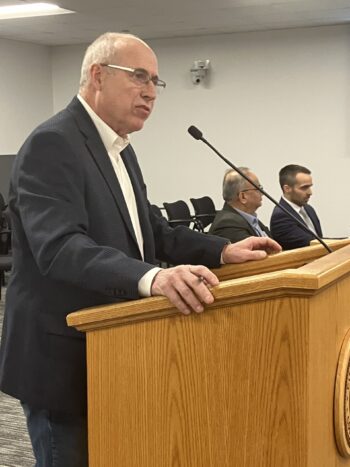
Other committee members supported the move with reservations.
“We have $20 million worth of property taxes that are designated as related to the pension plan,” observed committee member David Livingston. “We have this $2 million (in revenue) on the part of PPRT. So still there’s $8 million that has to come out of the General Fund to get to our $30 million contribution,” Livingston said.
Livingston also said whether the city wants to separate out the PPRT funds or continue to deposit them in the city’s General Fund with other property tax revenues in order to pay the full $30 million going to pensions, is “left pocket, right pocket.” He characterized the discussion of $2 million in tax funds as trivial in the context of a $30 million expenditure, noting that despite the time the committee has worked on the issue, questions remain on how the city should address pensions and a structural deficit.
Earmarking a revenue source for one specific category ‘not good tax policy’, member says.
Therese McGuire, appointed to the committee last year and a professor of strategy at the Northwestern University’s Kellogg School of Management, cast the lone dissenting vote.
“I was shocked actually to see this notion of a General Fund source of the City of Evanston being put aside into being used for one purpose in general,” she said. “It’s not good tax policy to earmark a revenue source for one specific spending category. Why? Because its future is uncertain and we don’t know if our priorities are going to change — we’re going to possibly need revenues for other priorities that the city has,” she said.
Kelly responded that the PPRT is regarded as a “non-discretionary expenditure” and pointed out that the budget shortfall in pension payments is largely a result of interest costs paid over the years.
She added that the city has been forced to pay interest “because we haven’t committed a responsible way to annually paying what the city owes. So, we are literally just throwing out $23 million to interest and fees to banks because we haven’t followed a firm policy.”
Kelly expressed hope that the city could find a couple of other sources to also go towards paying pensions.
Wednesday’s action also included setting aside a small percentage of PPRT funds, 11.3%, until the city’s “potential” liability to the library regarding dispersement of the tax is resolved.
Library officials, in the course of an outside finance analysis, maintained that PPRT funds have not been shared with that body though required under state law.
The issue is currently part of the discussion between the city and library regarding a revised Intergovernmental Agreement (IGA).