






By Bob Seidenberg
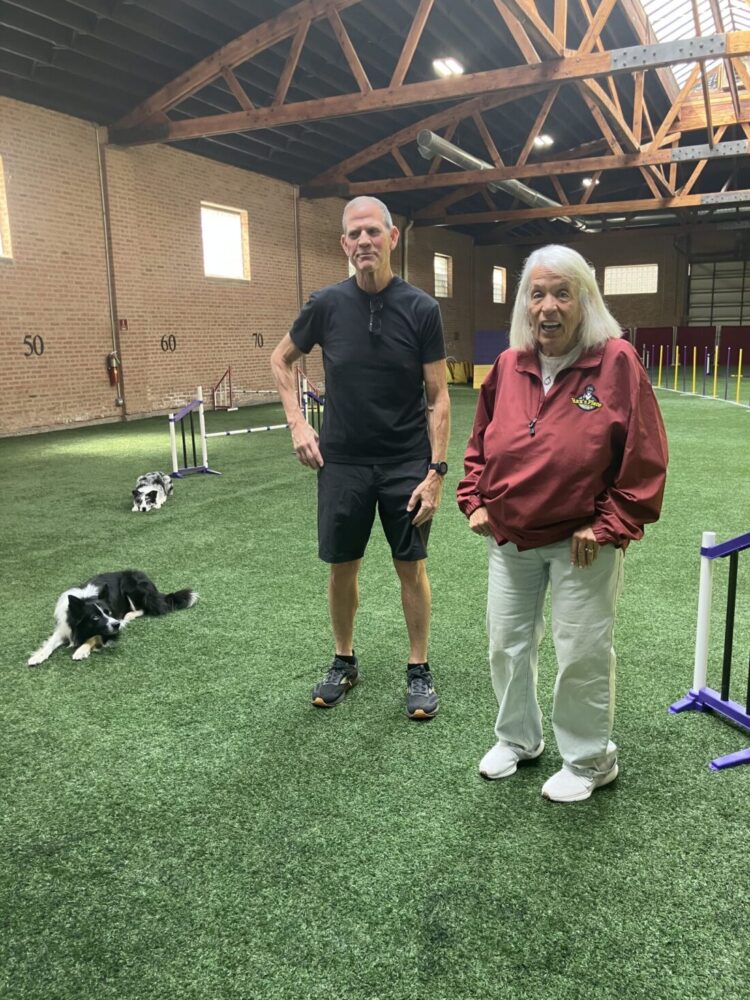
Rex’s Place, a combination dog daycare/training, boarding and sports arena, has been a part of the Fifth Ward since 2010, well before the business and warehouse portion of the ward began seeing a resurgence as the newly dubbed Ashland Arts District.
With support from prominent businessman Leon Robinson Jr., co-founder of the Robinson Bus Company (“a wonderful man,” said Rex’s Place owner Kathy Lichtenstein), Lichtenstein started out in a 1,500-square-foot space at 2120 Ashland Ave.
“It was me and my dog Rex,” she said, and the business name reflected that.
She also moved into the Fifth Ward, eventually buying two residences from Robinson.
In 2021, after Auto Doctor relocated to Dempster Street, Lichtenstein bought the building at 2114-2120 Ashland from Lynn Robinson, Leon’s daughter, who had taken over ownership after his death.
Lichtenstein said she spent $900,000 renovating the building, installing artificial turf in the sports arena, putting in a new plumbing and electrical system and restoring the original Chicago Red Brick in the former automobile repair shop.
Unfortunately, she found “the one thing we didn’t do” — the roof — had separated and needed to be replaced, as did three air conditioners.
Application for TIF assistance
Lichtenstein tucked many of those details about her history and personal investment into a three-page application to the city’s Economic Development Department, submitted in early May in support of her request to receive $640,000 in tax increment financing (TIF) assistance from the city to address those items. The property sits within the Five-Fifths TIF district, which was established in 2021, almost entirely in the Fifth Ward.
“We employ over 20 people and provide opportunity to several area students through internships and work programs,” she wrote. “We donate regularly to the Evanston Animal Shelter and help them, when asked, with providing space for shelter dogs to get socialized.
“During COVID we were considered an essential business and remained open throughout the virus to assist people in caring for their four-legged animals while they cared for themselves or others,” Lichtenstein wrote. “We serve between 80 to 130 dogs every day, either daycare or boarding. Our clients eat at Double Clutch or Soul & Smoke and many other places within Evanston when they drop their dogs off and pick them up.”
Through the business, which she plans to leave to employees after retirement, “we have seen children for the first time in car seats and who now drive their pups to the daycare.”
She noted two other businesses in the ward had previously received city TIF assistance — Soul & Smoke received a $650,000 grant in 2022, and Free Flow Kitchen received an $82,510 partially-forgivable loan in 2025.
Funding denied
A few weeks later, Lichtenstein said she received what she described as a “dismissive” letter and “patronizing” phone call.
In a June 1 email, Paul Zalmezak, the city’s economic development manager, thanked Lichtenstein for reaching out. “I’m sorry to hear about your current financial challenges,” he wrote.
“Your contributions to the community are greatly appreciated; however, the TIF cannot support this request,” he continued. “The TIF is too early in its creation and does not yet have sufficient increment. Furthermore, the TIF has an affordable housing priority and is gearing up for a significant support program and several infrastructure improvements.”
He then provided links to several other agencies where Lichtenstein might find funding for the repairs.
The Five-Fifths TIF also did not have sufficient money for Soul & Smoke’s 2022 request, so it “ported” money from the neighboring West Evanston TIF to cover the cost.
After being turned down, Lichtenstein said she also received a call from Councilmember Bobby Burns (5th Ward), whom she had copied on the original application. In his call he maintained her business was “not the same as Soul & Smoke” and that “I didn’t really contribute to the city by installing some turf in a building,” she said.
Upon receiving the denial, Lichtenstein responded to Zalmezak and Burns in a June 11 email, which was copied to members of the Economic Development Committee (EDC).
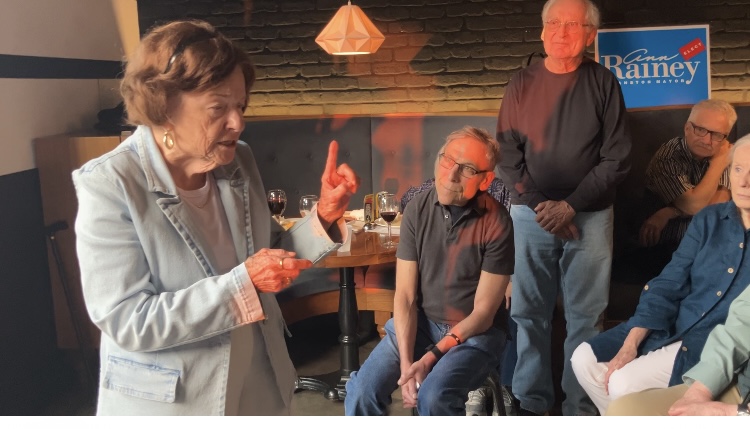
“Contrary to Paul’s insinuation that my business is having financial difficulty, we are not,” she wrote. “I was merely asking my city for help, which I have been repeatedly told in monthly business association meetings was available.”
“Every day I do have many of our 1,000 customers coming through Evanston, spending money in other Evanston establishments and patronizing what was an unsafe area when we first opened,” Lichtenstein said. “I do employ over 20 people for whom I pay taxes and who also buy meals and items from other businesses in Evanston. I do pay property taxes on three properties in Evanston — my commercial building and two private residences — and those are some of the highest property taxes in the area.”
“The fact that the owners of Soul & Smoke and Free Flow Kitchen sit on a TIF advisory board that has granted them TIF funds already reeks of corruption,” she said in the email she sent to EDC members. “The fact that I received a letter and phone call telling me, ‘I don’t have the right kind of business’ and ‘do not do as much for the city as they do,’ is insulting and beyond comprehension.”
Only one of the owners from each business serves on the Five-Fifths TIF Advisory Board, which is chaired by Burns. The panel only makes recommendations for TIF spending on “private affordable housing development” in the district and not on business assistance grants, which receive recommendations from the EDC.
Burns: Business owner’s comments ‘misrepresent’ conversation
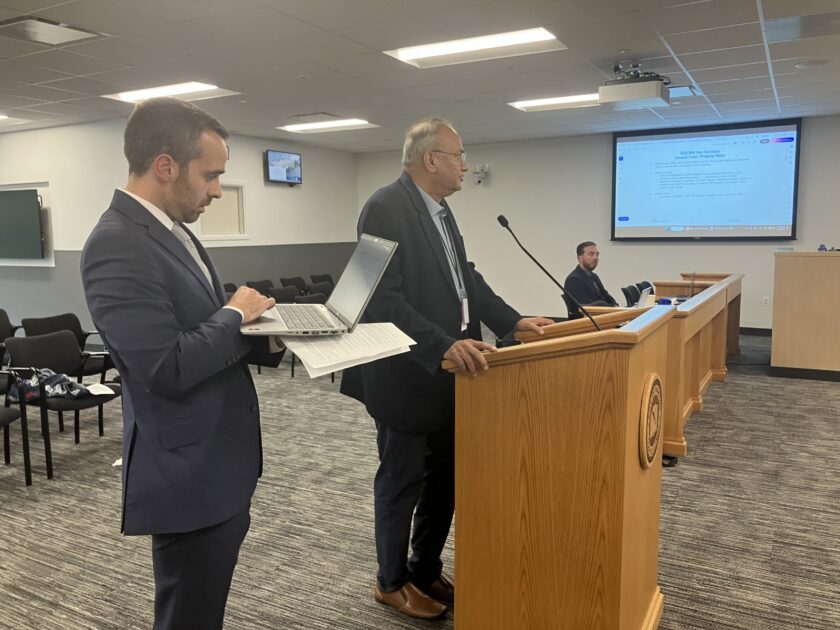
The application never advanced to EDC for a recommendation, but Lichtenstein repeated her concerns during public comment at the committee’s Aug. 26 meeting.

Most members sat silent after she made her charged comments, with Councilmember Clare Kelly (1st Ward), the current chair of the committee, being the lone member to respond. She noted that Lichtenstein’s comments dealt with a TIF matter.
“This is the Economic Development Committee, but your comments are very much appreciated, Ms. Lichtenstein, and I will say I have heard nothing but rave reviews about Rex’s — absolutely an asset to our community, so thank you,” Kelly said.
“We are a good business,” Lichtenstein said.
Burns, who did not attend the Aug. 26 meeting, responded to Lichtenstein in an email last week after being asked about her comments.
“Based on what I’m hearing, some of those comments continue to oversimplify or misrepresent our conversations,” he wrote to Lichtenstein, “particularly by leaving out what I have offered to do from the beginning.”
“At no point did I say that Rex’s Place does not contribute to Evanston,” he emphasized in a follow-up email. “We had a fairly detailed discussion about tax increment financing, property improvements, assessed value, and why different types of capital projects/TIF requests can produce different public and financial outcomes.”
He said the comparisons discussed were specifically between Rex’s Place’s TIF request and the TIF assistance provided to Soul & Smoke, which he strongly supported. “Those are materially different proposals,” he maintained.
“Soul & Smoke was approved for $650,000 in TIF assistance toward a project originally estimated at approximately $1.475 million; about 44% of the total cost, with the owners financing the majority themselves,” Burns wrote. “The project ultimately cost $2 million, making the City’s share 32% of the total project cost. It expanded the restaurant from approximately 1,500 to 6,500 square feet, included extensive permanent improvements, and was projected to create jobs and generate substantial additional sales and liquor tax revenue.”
“By contrast, Rex’s Place requested $640,000, 100% of the total improvement costs, to replace its roof and three aging air-conditioning units,” he continued. “Those are legitimate building needs and TIF-eligible expenses, but there is a meaningful difference between fully funding replacement of existing building systems and using public dollars to leverage a much larger private redevelopment.”
That distinction also matters for property value and TIF, he said. “Replacing aging systems primarily preserves an existing asset, while substantial redevelopment (such as Soul & Smoke’s request) can increase the market and assessed value of the real estate, generating additional TIF increment and ultimately strengthening the tax base for all taxing bodies [primarily District 65 and District 202] when the TIF expires. That is a distinction about the use of public dollars and the value created for the tax base, not whether a business contributes to the community,” he said.
Installing artificial turf, too, “does not materially alter the assessed or market value of the building or expand the tax base in the way that Soul & Smoke does,” he added.
Regarding the Soul & Smoke and Free Flow funding requests, he noted both went through the Economic Development Committee — of which neither restaurant’s owner is a member — and that final approval of such requests rests with City Council.
Burns said the city’s corporation counsel has ruled that it was not a conflict of interest for the restaurant owners to serve on the Five-Fifths TIF Advisory Committee.
When the issue came up in 2025, Burns said he subscribed to “a confluence of interest … that there would be a benefit as we try to advise the committee that we have people that live in the area, advising us how to best use the funds to kind of uplift this area.”
Zalmezak, also asked to respond, noted that the Five-Fifths TIF is designed to fund an affordable housing plan and small business repair.
“So maybe she qualifies for some smaller amount of TIF and we can have that conversation,” he said in a phone conversation Wednesday.
But he said return on investment is a consideration, too. “She [Lichtenstein] provides an excellent service,” he said. “Evanston would be a much worse place without her services, but she doesn’t generate a lot of sales tax [revenues] like a restaurant would, or somebody who’s selling alcohol.” Zalmezak said he considered his response to Lichtenstein’s request “factual, unemotional,” rather than “dismissive.”
“I’m sorry that she didn’t like it, but sometimes the facts are hurtful, and it’s not intentional,” he said. “We appreciate the business she provides, and I think we have been supportive of her,” he said, noting the drop-off zone the city has provided in a neighborhood short on parking.
Three quotes needed, Burns says
Burns said he has offered to work with Lichtenstein, specifically to understand her business’s need for a new roof.
“I have said that I am willing to help advocate for it if you provide three quotes, as the city typically requires for requests of this kind, preferably including one from a local contractor, and allow me to meet with you and the lowest bidder to better understand the scope of work and costs,” he reiterated in an email to her last week. “I first made that offer more than two months ago, but I still have not received the quotes or other information requested.”

Lichtenstein confirmed that Burns did bring up to her the necessity of “three quotes” in his call to her after her application had been rejected, telling her she didn’t have to be on site while he talked with the roofer about the scope of the roof project.
She didn’t ask him to do so. “I don’t know that it’s my alderman’s job to go on the roof and to even say to me, the building owner who owns the building, you don’t need to be there,” she said.
She said Thursday that she is moving ahead and hopes to get money on her own for the roof.
In the meantime, “if what Evanston is saying [is] the only businesses we value are businesses that give us sales tax,” Lichtenstein said, “then they are excluding … anyone that doesn’t have retail or doesn’t have liquor. They are telling [you], ‘Don’t do business here. You will never get help from us.’”
“How are we making it easier for new businesses to open or established businesses to stay? Our residential taxes are higher because of the number of vacant businesses,” she said to EDC members. “That means less commercial tax revenue for the city, and they make it up with the rest of us. Why is the city not a facilitator, a partner with small businesses, rather than an antagonist?”