




By Bob Seidenberg
An early retirement program may be among the cost-cutting measures on the table when city officials kick off the budget process next month.
At the city’s Finance & Budget Committee meeting Wednesday, city budget officials included an early retirement initiative as well as a voluntary separation program among the cost-cutting ideas they plan to present to the council next month.
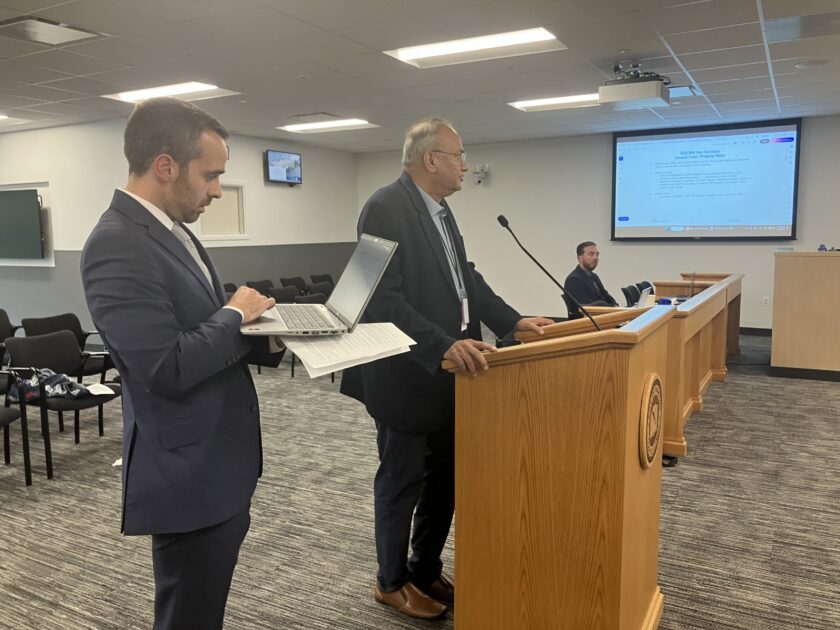
Although revenues are performing well above estimates at the mid-year mark of 2026 — with inflation playing a role in spiking the revenues the city is receiving through sales tax and other areas — the city is still contending with a deficit in the 2027 budget, ranging from $4.8 million to $10.6 million, Clayton Black, the city’s deputy chief financial officer, told committee members in his presentation.
All the same, “We’re still going to have a combination of cuts and revenues that are going to be required to not fully deplete the (city’s) reserves next year,” he said.
Some of the anticipated challenges he listed included the city’s continuing structural deficit between revenues and expenses, property taxes, public safety pension funding, expiration of federal and other grant funding, capital funding and major facility needs.
“We have data that essentially shows not only are delays from Cook County (in revenue disbursements to local municipalities) causing some problems,” Black said, “but the lack of a General Fund levy increase over the last 13 years for anything except public safety pensions, debt service and the Human Services” has had major impact too.
“While the General Fund levy has been largely flat during that time, we’ve drawn down $28 million over the last four years to make sure we meet our full pension obligation,” he said.
The city’s Capital Improvement Program is also in need of a major conversation, too, he said, “where we know we have some majority facilities (Police-Fire Headquarters, the city Service Center, Noyes Cultural Arts Center, the Evanston Public Library) without clear financing strategies for those we need to figure out.”
$2 million in savings possible in first year of early retirement plan
On the expense reduction side, staff suggested ideas to consider include service delivery optimization, credit card fee recovery, a review of staffing levels previously covered by grants and an early retirement initiative/voluntary separation program.
The early retirement programs could be offered to up to 102 employees covered under the Illinois Municipal Retirement Fund (IMRF) while the voluntary separation program would apply to 142 IMRF, police and fire department employees who qualify. Depending on how many employees would pursue it, first year savings could approach $2 million, followed by annual average savings of around $500,000 in ensuing years, officials estimated.

Recognizing “that our greatest expenses are people,” Black told committee members, “this offers a potential incentive for staff to take an earlier than planned retirements and potentially save the city some money.”
For IMRF employees, the program incentive would allow an employee to buy up to five years of service at a rate of 4.5% per year of service credit added.
Thus, an employee who is age 50 with 20 years of experience at the time the program went into effect could retire at 55 with 25 years of service credit, if approved for the program, he said.
The voluntary separation program, envisioned on the police and fire side too, would work differently, with the city deciding on the incentive to be used.
“Other communities that have done this have offered potentially a year of health insurance, some form of cash payout, typically tied to years of service with the community,” Black said.
The net cost of that program, if 60% of the people took it, would be about $2 million also for the city, with continued savings into the future, he said.
“But both of those programs assume that you don’t just go back out and replace the entire payroll that you would be taking off the books,” he said.
Several committee members keyed on that point in their reaction to the proposal.
Committee member David Livingston noted that the success of such a program could revolve around “how many jobs do you need to backfill,” and whether the city could combine that with a program or service they are already contemplating outsourcing.
He suggested a couple of additional cost-saving proposals the city might pursue — paring down the number of vehicles the city has, consolidation of purchases and community center profitability.
“I’d love to see the community center profitability,” he said. “I think it might open some people’s eyes to see how we have such an operating deficit at some individual facilities, and how do we shrink that back.”
Committee and Councilmember Clare Kelly (1st Ward) said that before even considering the retirement plan idea, “I would like us to first consider identify cuts in personnel. I am quite certain that there are anywhere from 25 to 30 cuts that we could make, and I think that’s important to identify that first.”
If the city adopted an early retirement plan route, she said control of the program is essential too, noting problems that cropped up with an early retirement program the city moved to in 2007.
In the 2007 early retirement program, nearly 60 employees left the city’s workforce, stripping senior staff members from Public Works, Human Services and Community Development departments.
Like Livingston, Kelly advocated looking for cost savings in several other areas — including removing those reserve policies for many of the city’s funds. In the past, she has argued that funds in many of the city’s 41 funds generated through fees on residents should not be banked but put back in use.
“We can keep a buffer, be conservative when we budget so we always have some, so we don’t go under,” she said, “but I think we should absolutely look at those fund balances and consider just removing the reserve policy from so many funds.”
Outsourcing work versus doing it in-house was another area she would like looked at. “I just visited Raymond Park the other day and saw the tot lot,” she told committee members. “It was so nice to see a park done in-house by our city and not a multimillion outsourced contract.”
Nieuwsma says it goes beyond reducing the headcount
Committee and Councilmember Jonathan Nieuwsma (4th Ward) said he shared Livingston’s concern about backfilling positions and the short-term effect of such a program, “which is going to make life more difficult for the existing employees and risk our ability to provide those services in a timely efficient manner to Evanston residents.”
Beyond early retirement, he said the fundamental issue that must be looked at in the budget is, “are we providing too much? You know, are we providing other services, programs that we don’t have to provide?”
If “we’re just kind of randomly reducing the headcount without taking a serious look at the underlying services that we deliver, we’re not doing the job completely,” he argued.
“I guess I’m just concerned,” he said, “if all we do is offer these programs, we are taking the easy way around the issue of having a very difficult and challenging budget discussion about what programs, projects, departments, divisions we might actually be able to cut — and I want to make sure we’re having those discussions.”
Another committee member, Candance Chow, maintained that there are “savings and even substantial savings even if positions are backfilled,” recalling her experience on the Evanston/Skokie School District 65 when the district implemented such programs.
With the employees than more on the senior end of service, the program helped to “recalibrate” the salaries.
At the same time, such a move “can’t be taken lightly,” she said, because then “there’s the cost in training and development, if you’re shifting the team to more of a junior team that needs development and support over time.”
She added to one of Livingston’s points about the need for a look at city vehicle use.
“Could we also look at the scope of vehicles that we have, and is there a way to pare that down so that we don’t have a lot of holding costs for repairs or parts?” she said, maintaining those problems can be avoided if the city had a more consolidated list.
Rodgers: In the future look at budget from bottom up
Committee member and Councilmember Matt Rodgers (8th Ward), chairing the meeting, said he shared the concern that focus on the early retirement program could “help us avoid the hard look at how we are staffed and if are we staffed properly.”
Rodgers said, “I would rather not see people take the early retirements (who) are more vital to our organization for our functioning than for a program that we’ve taken on that isn’t one of the key services we have to provide to residents all the time.”
School consolidation a discussion item?
At the end of the discussion, Kelly maintained another item that should make the city’s list when considering bottom-line impact on residents’ costs — the consolidation of the city’s two school districts — Evanston/Skokie School District 65 and Evanston Township High School District 202.
“I think we should start to discuss that and look at the potential savings and see if there’s something maybe our council wants to consider putting on as a referendum. Illinois is one of the states with the most numerous taxing bodies, and it leads to all kinds of problems and expenses and it makes it an incredibly expensive state to live in.”
No votes were taken on that issue or others at the meeting, with the budget set for discussion only.