






By Bob Seidenberg
An Illinois Department of Transportation audit of the city’s use of motor fuel tax funds is underway, with the department looking to reconcile usage of the funds with IDOT requirements, a spokesperson confirmed last week.
The audit is a “routine standard clerical response,” IDOT spokesperson Maria Castaneda wrote in a July 15 email.
“In general, if we find any issues we work with the municipality to find solutions, which can range from completing additional paperwork to paying back their MFT account if MFT funds were used for ineligible expenditures,” Castaneda said in the email.
Since last year, Councilmember Clare Kelly (1st Ward) has raised concerns about the gap between roughly $22 million that IDOT reports as the city’s total balance of unencumbered MFT funds and the $2.3 million of unencumbered dollars the city says it expects to have in the fund at the end of 2026.
Kelly took an interest in the matter when officials wanted to leverage debt for a project that could otherwise be funded with MFT dollars, and there appeared to be excess reserves in the MFT fund, she said.
“IDOT has systems in place to ensure that the taxpayers are getting the best possible value for their dollar and ensure transparency in the process,“ Kelly said after the July 8 Finance and Budget Committee meeting, where the issue came up. “So we legally cannot spend our motor fuel money without the authorization of IDOT.”
Kelly claimed the city has “been spending many millions of dollars on contracts using motor fuel tax money without the legal authorization of IDOT,” though that will likely ultimately be determined by the audit.
Mary Rosinski, a longtime resident and frequent commenter on city spending issues, also addressed this discrepancy during public comment at that June 8 meeting. Rosinski joined Kelly in researching the issue after the latter raised her initial concerns, and the two have obtained documents from IDOT through public records requests.
“What this says to me is we have a problem with our paperwork — or our reconciliation of that fund. There are contracts and paperwork dating back as far as I can find, to 2015, that don’t follow a clear track,” Rosinski told committee members.
“Now is the time to address these issues, and I’m asking the committee to write a reconciliation plan for every fund before the budget is finalized, and that plan needs to identify which funds and projects will be reconciled first, when the reconciliation will be completed and how the public and council will be able to review them.”
City official: State ‘many, many years behind’
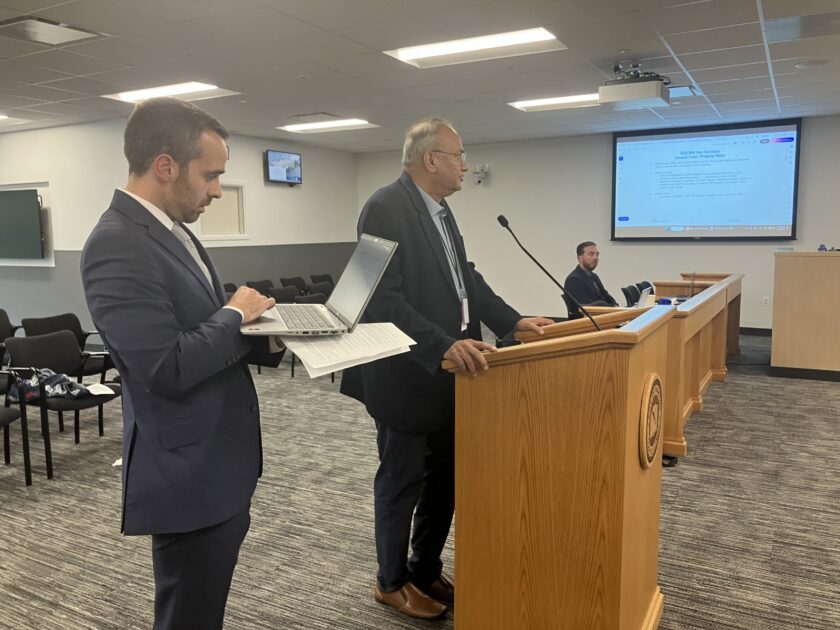
During a presentation at the July 8 meeting on the city’s many budget funds, Clayton Black, the city’s deputy chief financial officer, noted the reason the city’s MFT fund number “varies greatly from the number that the state reports is because the state is many, many years behind on clearing MFT expenses.”
Black said the agency’s audit of the city’s MFT spending should result in “clearing a bunch of money that has not been cleared by them due to delays over the past 10 years. Once those funds are cleared, the fund balance number that the state reports should be fairly close to this number,” referring to the city’s reported MFT fund balance of $2.3 million at the end of the year.
In committee discussion, Kelly said the movement is on the city’s part, from recently backfilling paperwork on projects already completed and paid. “That means the city never had the legal authority to spend the funds,” she asserted. “From the end of Jan. 2020 through June of 2025 there is only one authorization to spend MFT funds — May 16, 2023, and it’s for a project in 2015.”
Essentially, “a pretty straightforward three-step process” is established for how a municipality should go about legally spending MFT funds, Kelly argued. “First, you present the resolution voted on by council to expend the dollar amount for a given project. Second, you submit the advertisement to IDOT for their weekly contractors bulletin, as required by state law.
“It’s [the IDOT contractors list] a one-stop shop clearing house for Illinois,” she said.
Third, the city selects the lowest qualified bid and submits the selected contract to IDOT for approval, she said. Then the city can spend the money and start paying the contractor directly from its MFT funds, Kelly said.
”These steps have not been occurring over [the] years,” she maintained.
The city confirmed on Monday that it’s currently going through “a routine audit with IDOT to ensure that the City and State have all the necessary documentation,” according to city spokesperson Cynthia Vargas. “IDOT has asked for updated BLR [Bureau of Local Roads] forms, and one project from 2015 did go over the amount approved in the Resolution. The City is still reviewing all documentation requests with IDOT, and we expect the audit to be completed within the next few weeks.”
The city’s response to the audit carried a sense of urgency, according to emails obtained by the RoundTable through a public records request.
City Clerk Stephanie Mendoza led the operation, with a Public Works Agency crew dispatched to retrieve document boxes from the third floor and attic of the old Morton Civic Center at 2100 Ridge Ave.
“This request is time-sensitive,” Mendoza wrote in a June 10 email, “and I would appreciate having these items moved by the end of the week.” City Manager Luke Stowe, Deputy City Manager Carina Sánchez, Corporation Counsel Alex Ruggie and top Public Works Agency leaders were all copied on the message.
In one response, IDOT document technician Ami Wenz told officials that up to 2022, the city made lump sum transfers from the MFT account. “Unfortunately, I am unable to determine where and what some of these transfers were used for,” Wenz wrote. “If section numbers cannot be provided, reimbursement will be required,” meaning the city would have to pay MFT money back to IDOT in that scenario.
She also noted that some invoices concerned advertising contracts that were charged to the MFT fund. “We are not allowing these expenditures,” she wrote back. “All construction contracts must be advertised with IDOT. If the city wants to advertise in newspapers, that should be paid for from another fund.”
In her email to the RoundTable, IDOT spokesperson Castaneda noted the state is indeed a little bit behind on performing audits, such as the one underway in Evanston.
Also, she wrote, “Evanston is under an Agreement of Understanding with IDOT, which gives them some greater autonomy, so sometimes that also means there may be a bit more activity that is older than if they weren’t under an AOU.”
The review began in June and is estimated to be complete in late August. “Again, this is all very routine,” Castaneda said.