









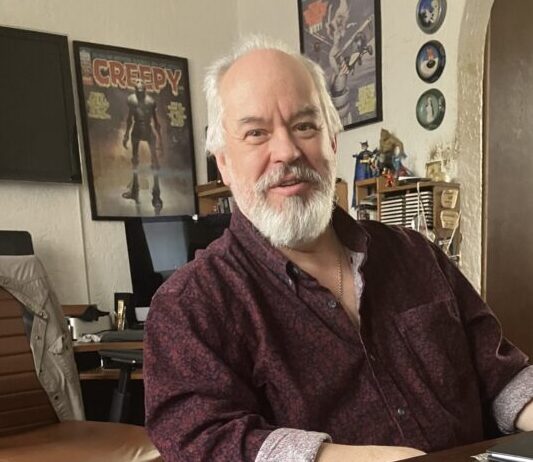
McKeon will read from his work, which features mug shots of historical figures, tonight from 6 to 10 p.m. at a Chicago gallery
By Bob Seidenberg
How would some of the world’s most famous historic figures fare in today’s world with its challenges to authoritarianism and standards of political correctness?
Probably not very well, suggests author and digital artist Tom McKeon, a longtime Evanston resident, in a dark and sometimes humorous view of the risky nature of free expression.
McKeon’s self-published book, Madmen, Hermits, Heretics, Dreamers, Rebels, and Skeptics features full-page illustrations of some of history’s most consequential figures, “ripped off their pedestals and cast as ‘Enemies of the State,’” McKeon writes.
His 24 illustrations with historical commentary below show some of history’s most consequential people in the frame of a mug shot, as “this is the outcome of their lives (jailed),” McKeon contends. “If they would have lived under an authoritarian power, they would all end up in the same place.”
McKeon is scheduled to read from his book at a joint “Tom@Tom” exhibit with gallery owner Tom Robinson, to be held from 6 to 10 p.m. Friday, May 8, at Robinson’s gallery at 416 W. North Ave. in Chicago. Another event will be held from 1 to 3 p.m. Saturday, May 9.
Copies of the book and prints are also for sale on McKeon’s website at www.imageryarts.com. A limited edition of around 100 copies of the book have been published by McKeon. It sells for $150, plus tax and shipping.

In an interview at his south Evanston condo, McKeon said an image he had of Renaissance painter Leonardo da Vinci in a mug shot served as the first inspiration for the book. “It’s just something I thought was funny,” he said. Like, Elf on a Shelf, he said. “And I started thinking of other people in mug shots and it got funnier.”
The original list of names he collected to join da Vinci grew and had to be pared down, he said. His final list includes the founders of several world religions, such as Buddha and Jesus, philosophers such as Socrates, and world-famous historical figures such as inventor and statesman Benjamin Franklin. It also includes contributors such as engineer Nikola Tesla and mid-19th-century English mathematician Ada Lovelace, who first showed how to embed code that would fire today’s computers.
‘People who actually made significant contributions’
One of the other individuals featured is English author Aldous Huxley, author of the 1932 dystopian novel Brave New World, who wrote about some of the concerns that McKeon features in his folio.
His crime came in that “he pretty much published a blueprint of an authoritarian power that controls its citizens through their base desires by appeasing those impulses,” McKeon writes. “There is nothing a magician protects more than the tricks of his trade, and Huxley’s writings pull the curtain back a bit too much.”
“Everyone in this book are people who actually made significant contributions,” he said. “I mean, what would the world have been without Descartes [17th Century French philosopher Rene Descartes], the guy who came up with using unknown integers.”
Descartes also contributed to the subtitle McKeon used to underscore his theme: “I think, therefore I am … arrested.”

McKeon said Socrates, the Greek philosopher, could serve as the group’s ambassador. “He ran afoul of powerful people — a smart guy making stupid people in control look stupid,” he said.
With historical photos not available in many cases, he used digital painting to create the images of the featured personalities, turning to AI in some cases for references about dress and other details of the period they lived in.
“And the mug shot is particularly apt in this case,” he says, “because that’s the tie that binds. They [the persons featured] all ended up in the same place — in a mug shot.”
Writing a preview of Friday night’s reading, radio host Diane Soubly noted that McKeon’s powerful illustrations along with historic statements end up “defining their iconic significance to the Artist as would-be Enemies of the State,” perhaps “because of their intellect, influence, outspokenness, bravery, inventive nature — even mere existence,” in a way which “begs us to engage in a similar pursuit of interest and intellect.”
McKeon said storytelling — such as through movies, animation and comic books — has been a major interest of his since landing on the North Shore at age 16.
He left film school at Columbia College after three years, using the money saved to buy a 16-millimeter camera. He used it to produce music videos, one of which caught the eye of a friend in the advertising business who passed word to his bosses.
At the Leo Burnett advertising agency, McKeon created a number of national commercials for clients such as McDonald’s, Heinz and Samsonite.
His early exposure to Mad Magazine, National Lampoon, Mel Brooks and later Stanley Kubrick infused the dark humor he dropped into his work, he says.
In the case of the trials faced by some of historic figures, “it’s a dark and dour thing to think about, so you got to (leaven) it with some humor a little bit,” McKeon says.