
By Bob Seidenberg
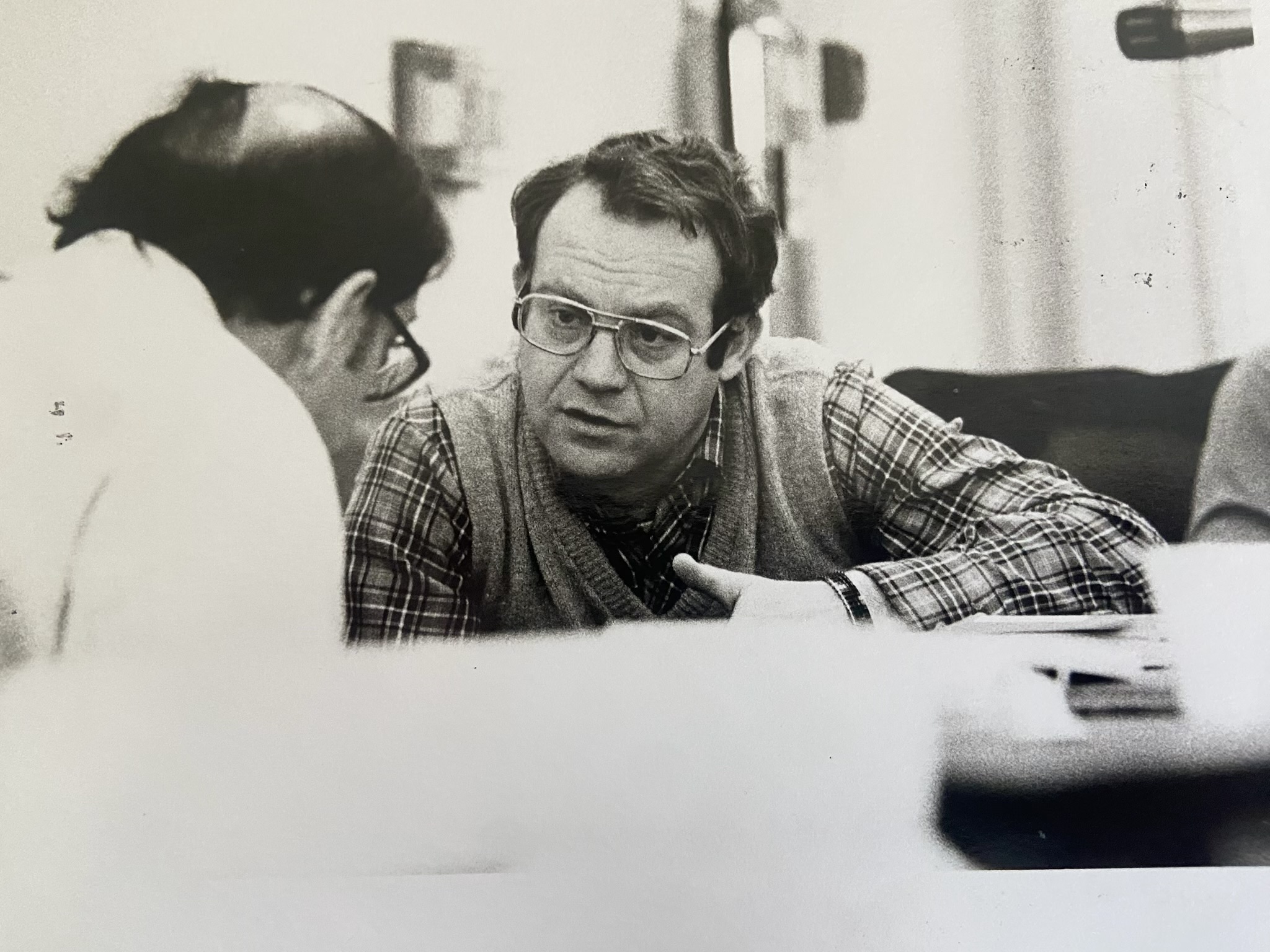
Don Borah, a Wilbur Wright College political science professor, got the chance to put classroom theory into practice as the feisty floor leader of the Evanston City Council in the late 1970s and early 1980s, falling just short of the mayor’s seat in 1985.
Borah died Dec. 21, 2025, after a nearly 10-year battle with prostate cancer. He was 85. A celebration of his life is scheduled from 1 to 3 p.m. Sunday, March 29, at the Levy Senior Center, 300 Dodge Ave.
Borah served as alderman of the city’s south Ninth Ward from 1977 to 1985, and often commanded the stage, as leader of the then 18-member council’s majority bloc, then embarking on an aggressive economic development program.
The council “floor leader” — a term sometimes used to describe Borah’s role — was “kind of a pejorative” term, recalled James “Jay” Lytle, mayor at the time. “But you know on economic development issues — we ran on a platform of economic development and as you know we did a lot of economic development. They [the issues] were sometimes controversial to pass and Don would put together coalitions to get it passed.”
Born in Chicago on Aug, 8, 1940, Borah was the son of the chief engineer of the Chicago Public Schools. He met his future wife, Susan, at age 5, when the two attended the same nursery school. “He sat right behind her,” recalled daughter Larissa Bruno, “because her name was an ‘A’ (Abelew) and his was a ‘B.’ ”

He attended North Park Academy for high school, leaving early to join the Marines in 1958, getting his GED degree while still in the service. Discharged in 1961, he returned to school at the University of Illinois, earning both bachelor’s and master’s degrees, with an emphasis on government and political science.
Distinguished
Wright College teacher
He started teaching at Wright College, one of the City Colleges of Chicago, in 1966, and earned a reputation as an excellent teacher. Don Barshis remembers sitting in one of Borah’s classes as a new dean at the school. “He was teaching a course on Karl Marx and Communism’s entry into the political scene at the turn of the 20th Century. And he just had that down — his back and forth with the kids in the class was just amazing. He almost did a Socratic method of asking them.”
Eventually named chairman of the political science department, Borah was honored with a distinguished professor award by the school at the end of his career, Barshis said.
Betsy Bouchard, a teacher in the English department at Wright at that time, noted that Borah was a popular lecturer and his classes were in demand, in spite of being demanding. “He was a valued member of our teachers union as well as a confidante of the President of the college,” she recalled in an email, “a tightrope he navigated without losing the respect of either side.”
A planned 280-bed nursing home spurred activism
Borah’s entry into local politics began in 1971. Soon after he and wife Sue moved into their prairie style home at 816 Seward St., they learned that three houses on the next block were to be torn down to be replaced by a 280-bed nursing home, he told Evanston Review editor Bruce Clorfene in a later interview.
After “a massive amount of work” by Borah, his wife and neighbors, residents were able to get the zoning board to change the block’s classification, stopping the nursing home from going through, Borah told Clorfene.
He didn’t blanch at a title bestowed on him as a “Protector of Sewers, Curbs and Gutters” in the interview.
“While I have the respect for the effort the council puts into social services and the like,” he told his interviewer, “the heart of the city for me are the things the quality of life depends on — sewers, curbs and gutters.”
After helping several other candidates get elected to the council, he declared it was his turn.
“I don’t like 60-day wonders who run after just discovering city council,” he told Clorfene.
Lytle: Took ‘a lot of grunt work’
When he joined the council in 1977, the city was going through a transition time where previous administrations “literally didn’t spend any money,” said Lytle. “That’s why our streetlights were 70 years old and our sewer system was out of date and we had a lot of unpaved streets in Evanston — our library needed to be replaced.”
With an 18-member council, meanwhile, “it took a lot of grunt work to get the legislation passed,” he noted. “He [Borah] would be talking with people, getting feedback from them. We’d tweak it to make sure we got everybody on board or as many as we needed to get on board.”
The new administration saw “increased planning and development activity, marked by the City of Evanston taking greater initiative and responsibility for the development process,” wrote Robert Teska, in a later economic history of that period.
A highlight of the period was completion of the 18-story, $24 million building at 1 American Plaza (now 1 Rotary Plaza), where the American Hospital Supply Corporation became the anchor tenant.
The city almost lost the deal, divulged Lytle, with American Hospital Supply concerned about not having financing. “Interest rates were sky high. It cost Jimmy Carter the election,” Lytle pointed out.
Working in tandem, the two brought a proposal to the council, which put the city in the second position, backing AHA’s financing.
Borah, the head of the council’s Economic Development Committee, was “very good” at explaining the proposal and its benefits to council members, Lytle said, helping clear the way for a major tax-paying corporation, and solidifying Evanston’s ”Headquarters City” reputation at the time.
A citywide perspective
With his political science background, Borah was necessarily detail-minded, sharing that trait with Joel Asprooth, the city manager whiz, pointed out Beth Davis, alderman for the Third Ward during the last two years of Borah’s term.
Drawing on his “affinity for the workings of the city, I think he [Borah] probably just augmented that for the council … that knowledge and so forth. But it wasn’t anything like, ‘Oh, let’s count up the votes on this’ or anything like that.”
At the same time, she said, “he never pitted the Ninth Ward against the lakefront wards, like some people on the council,” she said. “And you know, even just in those two years, I felt like he had that whole city view. And, of course, he ran for mayor which, you know, reflected that.”
A favorite for mayor’s seat
As Borah entered the 1985 election season, local Democrats had practically anointed him as their choice. His name topped a list of 100 candidates the local party presented to its members.
Though municipal elections are nonpartisan, the party was determined to break local Republicans’ hold on the seat and Lytle’s decision not to seek another term, seemingly opened up a prime opportunity.
Joan Barr, Second Ward alderman, a childhood friend of Lytle and, like him, a liberal Republican, particularly on social service matters, had already announced her candidacy.
But it was the unexpected entry of the Rev. John F. Norwood into the race that, in Lytle’s words, “changed everything.”
Norwood had served on the District 65 School Board but brought little past experience with local municipal affairs. Still, he attracted activists who resented Borah and the political establishment’s domineering style, particularly in the city’s hookup with Northwestern University on a research park venture some had raised concerns about.
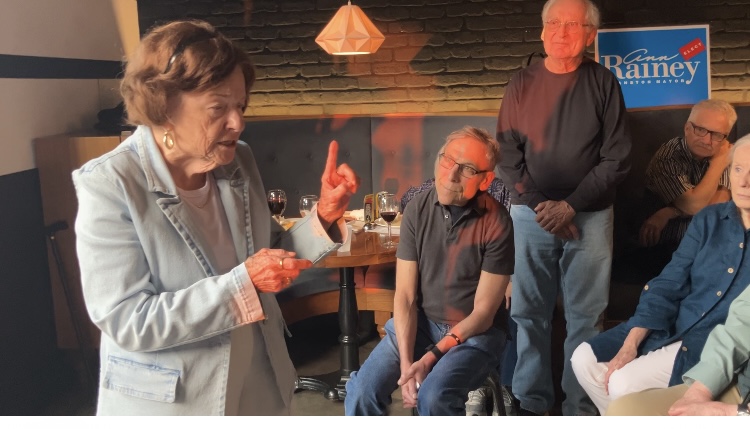
Ann Rainey, who would later run for mayor but was then Eighth Ward alderman, ended up backing Borah, to the surprise of some of her supporters.
“He had a problem with my being one of the founders of the tenants organization and so he told me one time … at a public hearing or a meeting, ‘One day, Ann Rainey, you’ll become a real citizen when you become a homeowner,’ ” Rainey recalled, laughing at the memory.

Even so, she said, “he was a leader on the council and, you know, he made a difference. And when push came to shove, and he and Barr declared for mayor, I said, “I can’t have her. I like her as a person. I’d like to go to dinner with her. I’ll socialize with her, but I don’t want her to be our mayor.”
Norwood’s entry, though, was still seen as pulling away from Borah’s solid Democratic base. Borah’s uncharacteristic change of council wear from a blazer to a jacket with patches on the sleeves was seized by some as confirmation he was seeking to soften his “suffer no fools” image.
The final tallies showed him losing to Barr by 759 votes from the 15,346 votes cast, with Norwood running a close third.
“We sat at his house drinking until about 2 a.m.,” recalled Emily Guthrie, then a young volunteer in Borah’s field operation and future Third Ward alderman from 1993 to 1997, “and just trying to figure out what happened. We didn’t expect it to be that much of a spoiler.”
Later life: Sierra Club volunteer, travel
Borah had given up his ward seat to run for mayor and so the election brought an abrupt end to a public career that saw him rise to a leader’s seat.
He rarely made references to it in conversations and relations with former and current council members.
“From a family perspective,” said his daughter Larissa, at the time a teenager, “I think we were of course disappointed and sad about it, but we were also in a way relieved, because you know it took a big chunk of his time out of our lives, you know, phone calls at night, constantly having meetings.”
That summer after the loss, “we took a three-month family vacation in Europe. And it really kind of brought us close together,” she said.

Travel became an increasingly big part of the Borahs’ lives, especially after the end of Don’s teaching career in 2000. Betsy Bouchard, also retired from Wright at that time, had inherited a Texas ranch from her grandfather, “so beginning around February 2005,” she wrote, “Don and Sue would saddle up their van and leave Chicago for a summer long trip, stopping at friends’ homes, spending a week at the ranch, then down to Big Bend National Park for a work stint with buddies from the Sierra Club, and from there westward for the remainder of the summer.”
In the Sierra Club outings, Barshis said, the Borahs would join others for sometimes months at a time, cutting out “invasive bushes and stuff. They would add gravel and repave stuff that had deteriorated over the course of the year.”
They also made trips to Europe regularly, with Borah storing his Volkswagen camper at a friend’s Germany garage.
“He didn’t just read books and kind of live a sheltered life,” Barshis said. “He saw the world and enjoyed it.”
He also stayed in contact with his fellow council members, said Davis, including keeping tabs on their health and alerting others, she said.
Coleen Burrus, who would serve as Ninth Ward alderman from 2009 to 2015, remembered meeting with Borah as she was preparing to run for office in his old ward, “and he grilled me for a couple of hours,” she said. “And you know as Don does …we became sort of fast friends.”
They continued to stay in touch on her trips back to Evanston after she had left the council and took a job at Princeton University’s Strategic Partnerships and Engagement office.
“We would have long conversations about who’s who now in the aldermanic seats, who’s mayor,” she said. “So it [Evanston] was home to him and he took great pride in the work he had done as an alderman. It was [his death] just a huge loss to the community,” she said.
Borah is survived by his spouse, Susan Borah, daughter Larissa Bruno, son-in-law Frank Bruno, grandson Frankie Bruno and grandson Chris Bruno (Madalyn Bochantine, his fiancé.)
Contributions can be made in Borah’s name to his favorite charities, which included the National Parks Conservation Association, American Institute for Cancer Research and the Sierra Club Foundation.