








By Bob Seidenberg
Evanston’s Police Department’s arsenal of body-worn cameras, Tasers and drones will expand under a $5.8 million seven-year contract approved by the Evanston Council Monday night
Council members voted 7-2 in favor of the contract with Axon Enterprise Inc., a leading company in the public safety technology field, facing the possible loss of a “discount” Axon was offering: savings of approximately $470,000 over the full life of the contract if the city acted before the end of the year.
A move by Council member Clare Kelly to table the issue to allow the city to get comparable with cities that have similar packages was voted down.
“I don’t want to feel rushed for a (seven-year) contract, which is very long in terms of cost for our residents,” she said.
Axon FUSUS platform raises concerns of Flock, federal intervention
Under the contract, Axon is to provide a comprehensive suite of services for the department, including 150 Tasers, 150 body-worn cameras and four drones, up from the one the department currently shares with the fire department.
In addition the new contract includes integration with the Axon FUSUS Real-Time Crime Center (RTIC) platform to more efficiently and effectively support police response to critical incidents,” police and city officials said.
Voting in support of the contract were council members Krissie Harris, 2nd; Shawn Iles, 3rd; Jonathan Nieuwsma 4th; Bobby Burns, 5th; Tom Suffredin, 6th; Parielle Davis, 7th; and Matt Rodgers, 8th.
Voting against were council members, Clare Kelly, 1st, and Juan Geracaris, 9th.
For a good part of the discussion, council members had appeared they might be willing to incur a penalty for not acting on the contract by the end of the year, exploring further concerns about price and privacy under an expanded system.
Several took note of the system’s use of FUSES (Filesystem in Userspace) — built around data access and permissions — citing the city’s own experience with Flock cameras. The Evanston Police Department deactivated that system in August of this year, no longer collecting or providing license plate reader data to the Flock network.
Kelly observed, “normally aggregating a lot of information together and centralizing is a good thing, like for health and anything else. But in this case, it really makes it that much more vulnerable to have so much information aggregated all into one, and that really is the issue. It’s vulnerable.”
She pointed to the current administration’s “disregard for law and increased authoritarianism,” as a reason to be concerned.
Similarly, she asked about the department’s added of drones provided under the new contract, increasing from one currently (shared with the Fire Department) to four. Deputy Police Commander Jody Wright, leading the presentation for the department, provided the number, responding to questions from Kelly.
Worst-case scenario requested
Geracaris, familiar with IT systems as a Senior System Administrator at Northwestern’s Kellogg School of Management, acknowledged that body cameras have served as a really important tool for the city. “I think we all agree that we needed an accountability.”
He said FUSES, though, “with new AI tools and all that’s emerging, for me personally, I have a lot of questions about.”
“Is this something that we can remove and move forward without?” he asked.
Mayor Daniel Biss, who under city council rules normally doesn’t take part in council discussions, also raised concerns asking city officials as well as Axon representatives in the audience, for “a worst-case scenario in terms of how it can misused.”
“And I want to be really, really clear…that we unfortunately don’t have the luxury of acting as though insane things won’t happen or dystopian sci-fi fantasies won’t come true because we all watched it,” said the mayor, who didn’t push further after officials offered an explanation of safeguards in the system.
Evanston Police maintain that they retain exclusive control over all stored videos and evidence , noting the information is kept in accordance with state statute under the Illinois Body Worn Camera Act. “Axon does not have access to police department data and will defer any court orders for such to the police department,” police and city officials maintained in a memo.
Wright maintained that there is no additional information that the federal government will get as a result of the changes.
Technology can make a difference
At the Nov. 11 city Finance & Budget Committee meeting, Wright had told committee members, “What’s unique about Axon is their ecosystem — everything is integrated together, so everything works in harmony with each other,” he said. For instance, if examining body worn video from a crime scene, “I can look at that video. I can look at that video and I can tell you who on the scene…just from looking at the video, because it’s smart [using ‘smart’ technology.]
“When I want to save the video to a case file,” he continued, “I can capture all the video from all the officers on scene, as well as Taser fire logs, I can capture the not just the body-worn camera video that may have captured an incident, but also the fleet cameras as well. So all of those systems work together. If we were to go out and look at that for each service individually … if that competitor doesn’t integrate with our Tasers, it makes the job that much harder for the supervisors and us as a department.’”
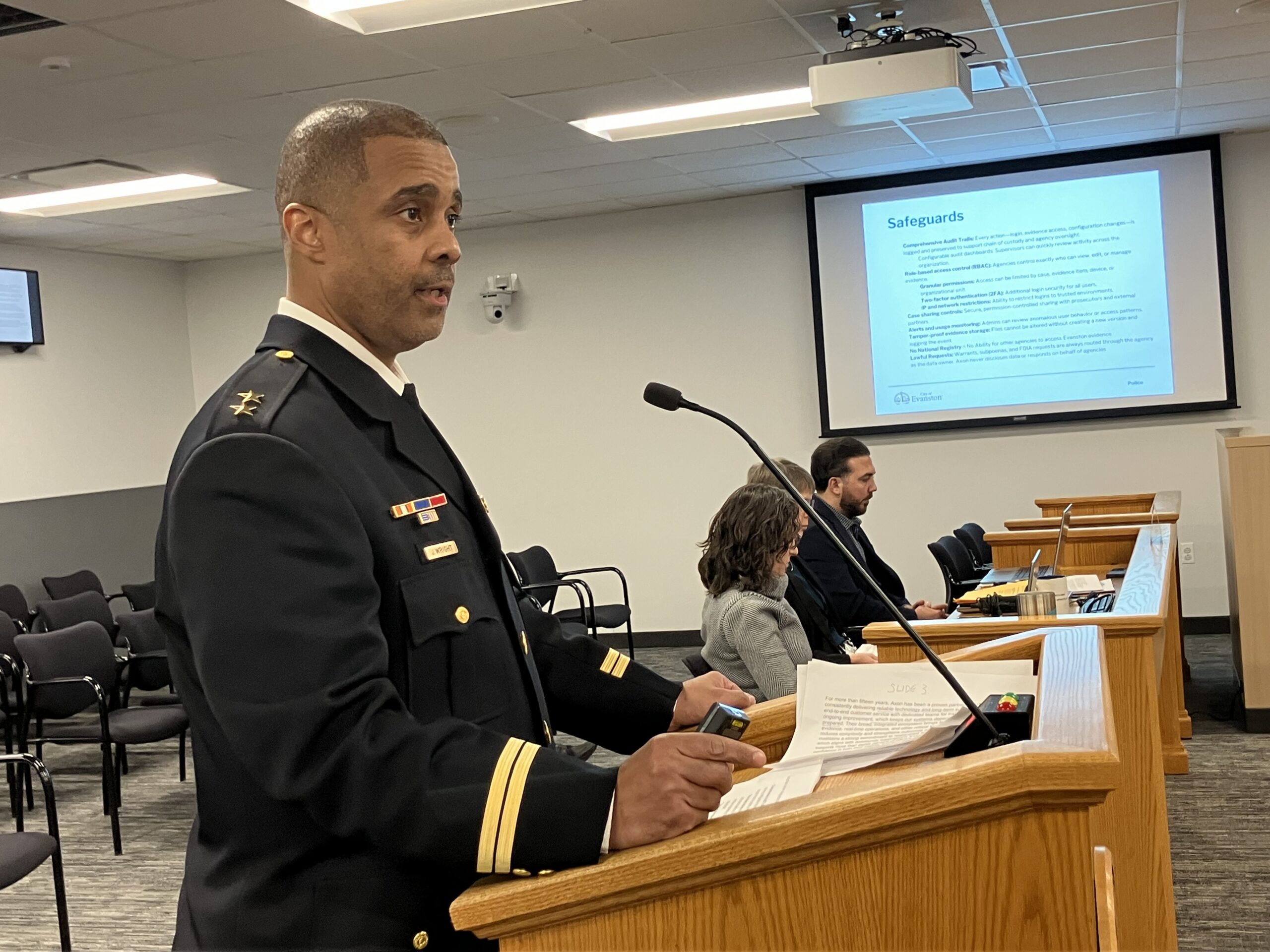
He told council members on Monday, “The technology is there to support police departments, “putting ourselves in a position where we have to ability to use it and have it as an organization, because you never know when something’s going to happen and to not acquire (it) for safety purposes, I think … it’s irresponsible. We’ve can sit back and say, ‘Well, this is Evanston. Highland Park, no one thought it was going to happen there, and if they had these tools like this in place, maybe you aren’t searching for a bad guy throughout the day.”
Price an issue too
Expanding on that, Burns noted that as far as the body- worn cameras were concerns, “This is not discretionary. We have to do this. Our officers are required to wear these, and it is a good thing. This is something that activists from around the country, around the state fought for.”
He and others also raised concern about the pricing terms of the contract.
Under the seven-year contract, costs would climb approximately to $850,000. The current Axon contract averages roughly $500,000 per year, police officials pointed out.
‘Less militarization’ of police needed: Speaker
“Can you just tell me why you feel this is the best cost for us?” Burns asked about the proposal, which was not competitively bid.
He also expressed concern that officials had not supplied council members with a copy of the proposed contract in the their information packets, as had been done at the Finance & Budget Committee meeting, maintaining if that had been done “there would have been less concerns.”
Responding, City Manager Luke Stowe said officials “researched many other communities to see what they are paying for comparable programs to ensure that we weren’t paying for an outlier.”
Earlier, during public comment, several speakers registered concern.
“You know this Axon contract makes Flock video look like peanuts,” maintained one, declining to give his name. “Slow down on this contract, let’s talk about it, and look at the evidence and look at the facts about what is actually we’re buying here.”
Longtime Second Ward resident Trisha Connolly maintained, “We need less, not more militarization of our police force.”
She said while Axon is looking to bolster the publicly traded stock for its shareholders, “that shouldn’t be our goal.”
